
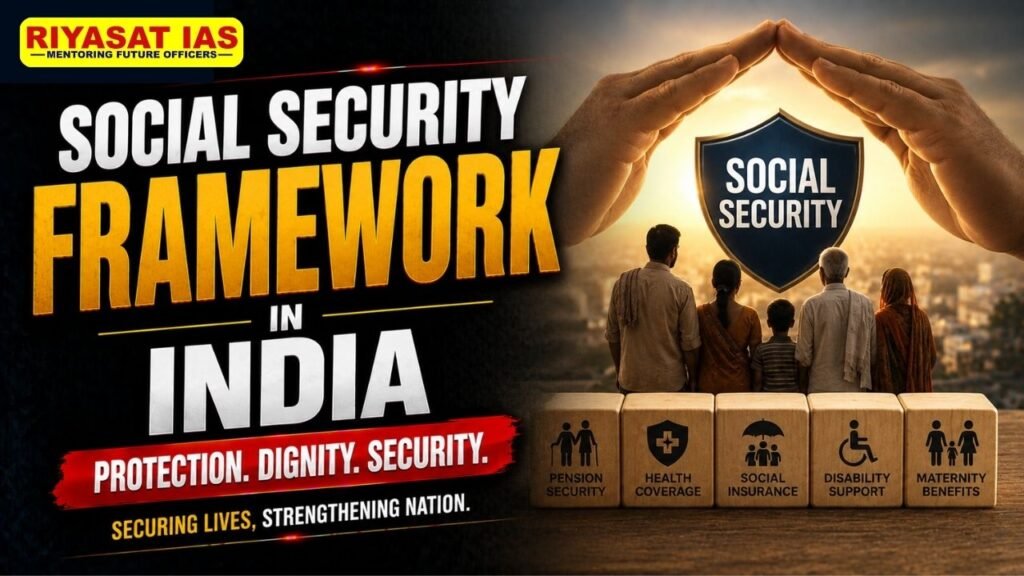
The social security system in India is changing significantly. The traditional paradigm, which is mostly associated with formal employment, is progressively broadening to include migrants, gig and platform workers, unorganised workers, and other vulnerable populations.
The coming into force of the Code on Social Security, 2020 on 21 November 2025, the expansion of the e-Shram portal, wider health protection under Ayushman Bharat, and employment-linked initiatives such as PM Viksit Bharat Rozgar Yojana mark important steps towards a broader social protection framework.
The central challenge now is to move from a fragmented, scheme-based approach towards a universal, portable and responsive social security system that protects workers across changing forms of employment.
What is Social Security?
Social security refers to policies and programmes that protect individuals and households against major economic and social risks such as old age, illness, disability, workplace accidents, maternity, loss of livelihood and inadequate income.
For India, social security is particularly important because a large share of workers are outside conventional employer–employee relationships. This makes employer-linked pensions, insurance and provident-fund systems difficult to extend universally.
Current Status of Social Security in India
India has significantly expanded social protection infrastructure in recent years, but coverage remains uneven.
- Large Informal Workforce: Informal employment continues to account for a substantial share of India’s workforce. Therefore, expanding social protection beyond conventional formal employment remains a major policy priority. The older 91% figure should not be presented as a current 2026 estimate without qualification.
- e-Shram Expansion: As of 14 July 2026, more than 31.78 crore unorganised workers were registered on the e-Shram portal. The database includes unorganised, migrant, gig and platform workers.
- Growing Gig Workforce: NITI Aayog estimated 7.7 million gig and platform workers in 2020–21, with the number projected to reach 23.5 million by 2029–30. This makes gig workers an increasingly important part of India’s social security debate.
- Formalisation of Employment: The PM Viksit Bharat Rozgar Yojana (PM-VBRY) aims to incentivise more than 3.5 crore jobs during its two-year registration period from August 2025 to July 2027, while promoting formalisation and expansion of social security coverage.
- Health Protection: Under AB-PMJAY, 43.52 crore Ayushman cards had been created as of 28 February 2026, while the scheme had authorised 11.69 crore hospital admissions worth about ₹1.73 lakh crore.
Major Pillars of India’s Social Security System
India’s social security architecture now combines legislation, worker databases, pensions, insurance, healthcare and employment-linked measures.
Code on Social Security, 2020
Legal Foundation: The Code consolidates nine central labour laws relating to social security. Importantly, it formally recognises gig workers and platform workers and provides for social security measures covering areas such as life and disability protection, accident insurance, health and maternity benefits and old-age protection. The Code came into force on 21 November 2025.
It also provides for a Social Security Fund and a National Social Security Board for gig and platform workers.
e-Shram Portal
Digital Social Protection Infrastructure: Launched in August 2021, e-Shram creates a national database of unorganised workers and provides registered workers with a Universal Account Number (UAN).
As of July 2026, registrations had crossed 31.78 crore. The platform has also been linked with services such as National Career Service, Skill India Digital Hub and PM-SYM.
Pension and Insurance Schemes
Income and Risk Protection: Schemes such as PM-SYM, Atal Pension Yojana, PMJJBY and PMSBY provide different forms of pension, life insurance and accident protection, particularly for workers outside conventional formal employment.



Ayushman Bharat
Health Security: AB-PMJAY provides health assurance of up to ₹5 lakh per family per year for eligible beneficiaries. Its coverage has also been expanded to all citizens aged 70 years and above, irrespective of socio-economic status.
The scheme also incorporates national portability, allowing beneficiaries to access cashless treatment at empanelled hospitals outside their home State. This is particularly relevant for migrant workers.
Employment-Linked Social Protection
PM-VBRY: The Pradhan Mantri Viksit Bharat Rozgar Yojana links employment generation with formalisation and social security. By June 2026, the scheme had brought 70 lakh first-time employees into the formal workforce since August 2025, according to the government.
Social Security for Gig and Platform Workers
Gig work presents a new challenge because workers may not have a conventional employer responsible for their social security.
The Code on Social Security, 2020 is significant because it explicitly recognises gig and platform workers and provides a legal framework for developing social security measures for them.
The government has also taken steps to bring platform workers into e-Shram. An Aggregator Module was launched in December 2024 to facilitate registration of aggregators and their platform workers. By January 2026, 12 major aggregators had been onboarded, including Zomato, Swiggy, Uber, Ola, Urban Company, Amazon and others.
This is an important shift from treating gig work merely as a new employment category towards recognising the need for portable social protection.
Why Does India Need Universal Social Security?
A changing labour market makes a purely employer-based social security model increasingly inadequate.
- Changing Nature of Work: Workers increasingly move between formal employment, informal work, self-employment, contract work and platform-based jobs.
- Portability of Benefits: Social security should follow the worker rather than remain tied to a particular employer, occupation or State.
- Fragmented Coverage: Multiple schemes aimed at different occupational categories can create gaps in protection.
- Worker Classification: Narrow definitions may exclude workers whose employment does not fit neatly into conventional categories.
- Protection Against Shocks: Health emergencies, accidents, disability and loss of income can push vulnerable households back into poverty.
- Gender and Care Responsibilities: Women often face discontinuous employment and unpaid care responsibilities, making portable pensions, maternity protection and health coverage particularly important.
Key Challenges
Fragmented Social Protection
Multiple Schemes: India’s social security architecture involves several ministries, schemes and institutions. Greater integration is required to make benefits easier to access.
Implementation Gaps
Last-Mile Delivery: Registration alone does not guarantee effective protection. Awareness, eligibility verification, timely payments, grievance redressal and administrative capacity remain important.
Gig Worker Protection
New Employment Relationships: Platform workers often lack a conventional employer who can contribute to pensions, insurance and other benefits, creating the need for new financing and governance mechanisms.
Limited Portability
Migrant Workers: Workers moving across States may face difficulties accessing benefits linked to location or local registration. Digital portability can help address this gap.
Digital Exclusion
Technology Divide: Digital platforms can improve targeting and transparency, but workers with limited digital access, documentation or digital literacy may remain excluded.
Financing Social Security
Sustainable Funding: Expanding coverage requires predictable financing. A universal system must balance government support, employer or aggregator contributions and worker contributions without imposing excessive costs on low-income workers.
What Reforms Are Needed?
- Universal Social Protection Floor: Establish a minimum level of protection covering essential risks such as healthcare, disability, maternity and old age.
- Portable Benefits: Ensure that benefits remain accessible when workers change jobs, occupations or States.
- Integrate e-Shram: Use e-Shram as an interoperable gateway connecting eligible workers with relevant welfare, pension, insurance and employment schemes.
- Strengthen Gig Worker Protection: Develop clear contribution mechanisms and benefit structures for gig and platform workers.
- Improve Welfare Governance: Strengthen transparency, monitoring, grievance redressal and outcome-based evaluation.
- Expand Awareness: Simplify registration and improve awareness of available pension, insurance and welfare programmes.
- Strengthen Centre–State Coordination: Develop common national standards while allowing States flexibility to address local requirements.
- Protect Digital Inclusion: Maintain assisted and offline channels for workers who cannot easily access digital platforms.
Social Security and the Changing Idea of Formalisation
India’s employment structure is becoming increasingly diverse. A person may work in agriculture, construction, self-employment, formal employment or the gig economy at different stages of life.
Therefore, formalisation should not be measured only by whether a worker has a formal employer. Access to social security itself can become an important indicator of economic formalisation.
The objective should be to create a system in which the worker carries social protection across employment transitions.
Conclusion
India is moving towards a broader social security architecture that combines legal protection, digital worker registration, healthcare, pensions, insurance and employment-linked incentives.
The Code on Social Security, e-Shram, AB-PMJAY and PM-VBRY provide important building blocks. The next challenge is to connect these components into a universal, portable and financially sustainable social protection system.
The rapid expansion of e-Shram to more than 31.78 crore registrations and the formal recognition of gig and platform workers under the Social Security Code indicate that India’s social protection framework is moving beyond the traditional formal-worker model.
The long-term goal should therefore be not merely to formalise employment, but to formalise access to dignity, protection and economic security.
FAQs on Social Security Framework in India
What is social security in India?
Social security refers to government and institutional measures that protect people against risks such as illness, disability, old age, accidents, maternity and loss of livelihood.
What is the Code on Social Security, 2020?
The Code on Social Security, 2020 consolidates nine central labour laws and creates a broader framework for social security, including provisions for unorganised, gig and platform workers. It came into force on 21 November 2025.
What is e-Shram?
e-Shram is a national database of unorganised workers launched in 2021. Registered workers receive a Universal Account Number that can facilitate access to social security and welfare programmes. As of 14 July 2026, more than 31.78 crore workers were registered.
Are gig workers covered under social security in India?
Yes. The Social Security Code formally recognises gig and platform workers and provides for social security measures covering areas such as accident, life and disability protection, health, maternity and old-age benefits.
How many gig workers are there in India?
NITI Aayog estimated 7.7 million gig and platform workers in 2020–21 and projected that the number could reach 23.5 million by 2029–30.
What is the role of Ayushman Bharat in social security?
AB-PMJAY provides health assurance of up to ₹5 lakh per family per year for eligible beneficiaries. Coverage has also been extended to all citizens aged 70 years and above.
What is PM-VBRY?
Pradhan Mantri Viksit Bharat Rozgar Yojana is an employment-linked incentive programme designed to promote job creation, formalisation and expansion of social security coverage. It aims to incentivise more than 3.5 crore jobs over two years.
Why is portable social security important?
Portable benefits allow workers to retain access to social protection when they change jobs, occupations or States. This is particularly important for migrant, informal and gig workers.
What is the biggest challenge for India’s social security system?
The major challenge is moving from a fragmented, employment-linked model to an integrated system that provides affordable, portable and accessible protection to workers across different forms of employment.


 Ravi Raaz
 Hassan Khan
 Shadab Ali