
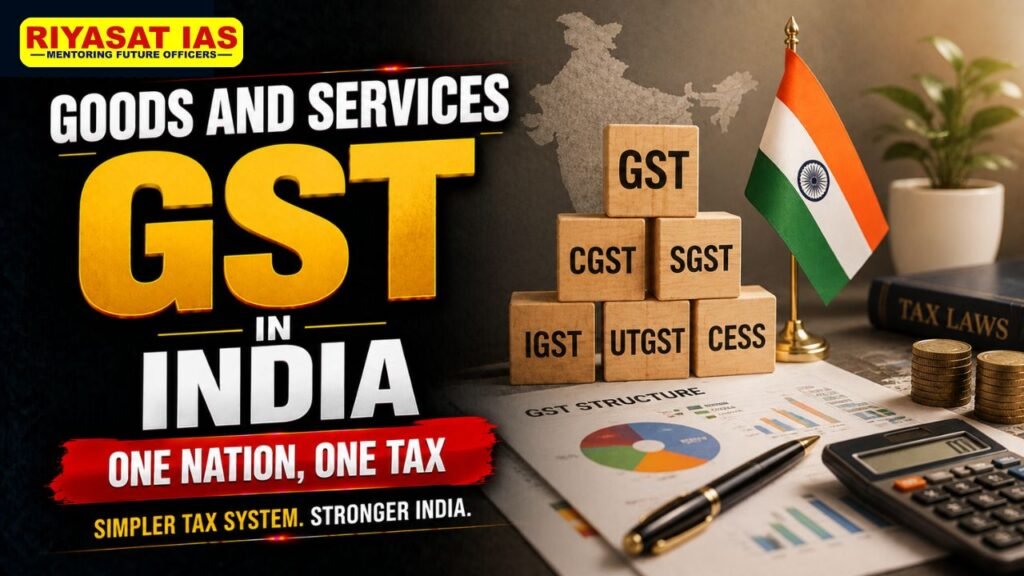
The Goods and Services Tax (GST) is one of India’s major indirect-tax reforms. Introduced on 1 July 2017, it brought several central and state indirect taxes into a common framework and aimed to create a more integrated national market.
GST is linked to the supply of goods and services and uses an input-tax-credit mechanism to reduce cascading taxation. Its dual structure also reflects India’s federal system, with both the Union and State Governments participating in GST administration.
What is GST?
Goods and Services Tax (GST) is a consumption-based indirect tax imposed on the supply of goods and services. Businesses collect GST and deposit it with the government, while the final economic burden generally falls on the consumer.
The system taxes value addition across the supply chain. Subject to prescribed conditions, businesses can claim eligible input tax credit for GST paid on purchases, reducing repeated taxation of the same value.
Why Was GST Introduced?
• Creating a Common Market: Reduce tax-related barriers to the movement of goods and services across States.
• Reducing Tax Cascading: Allow eligible input tax credits across the supply chain.
• Simplifying Indirect Taxation: Bring several taxes under a common framework.
• Improving Compliance: Use technology to make registration, return filing and tax payments more transparent.
• Supporting Formalisation: Create stronger digital records of business transactions.
How Did GST Evolve in India?
• 2003 – Kelkar Task Force: The task force on indirect taxes recommended moving towards a comprehensive GST framework.
• 2006 – Union Budget: The government indicated its intention to introduce a national GST.
• 2014 – Constitutional Amendment Bill: The Constitution (122nd Amendment) Bill was introduced to provide the constitutional foundation for GST.
• 2016 – Constitutional Amendment: The 101st Constitutional Amendment Act, 2016 created the constitutional framework for GST.
• 1 July 2017 – Implementation: GST came into operation across India.
Constitutional Framework of GST
• Article 246A: Gives Parliament and State Legislatures concurrent powers to make GST laws, with Parliament having exclusive power over inter-State supplies.
• Article 269A: Provides for the levy and collection of GST on inter-State supplies and its distribution between the Union and States.
• Article 279A: Provides for the GST Council, the constitutional body that makes recommendations on important GST matters.
Key Features of GST
• Tax on Supply: GST is based on the supply of goods and services rather than simply on manufacture or sale.
• Destination-Based Tax: Tax revenue is linked primarily to the place where goods or services are consumed.
• Dual Structure: The Indian model allows both the Centre and States to levy GST on intra-State supplies.
• Input Tax Credit: Businesses can generally offset eligible GST paid on inputs against their output-tax liability.
• Technology-Driven Administration: Registration, returns, payments and several compliance processes operate through digital platforms.
• Threshold Exemption: Smaller businesses may qualify for exemption or simplified compliance subject to prescribed conditions.



Components of GST
India follows a dual GST model. Its principal components are:
| Component | Generally Applicable To | Collected By |
| CGST | Intra-State supply | Central Government |
| SGST | Intra-State supply | State Government |
| UTGST | Intra-UT supply | Union Territory |
| IGST | Inter-State supply / imports | Central Government, with prescribed settlement |
Taxes Subsumed into GST
Central Taxes
• Service Tax: Was subsumed into the GST framework.
• Central Excise Duty on specified goods: Was subsumed into the GST framework.
• Additional Duties of Excise: Was subsumed into the GST framework.
• Additional Duties of Customs, commonly referred to as CVD and SAD: Was subsumed into the GST framework.
• Certain Central cesses and surcharges relating to the supply of goods and services: Was subsumed into the GST framework.
State Taxes
• State VAT/Sales Tax: Was subsumed into the GST framework.
• Purchase Tax: Was subsumed into the GST framework.
• State Entertainment Tax: Was subsumed into the GST framework.
• Luxury Tax: Was subsumed into the GST framework.
• Entry Tax and Octroi: Was subsumed into the GST framework.
• Certain taxes on lotteries, betting and gambling: Was subsumed into the GST framework.
• Relevant State cesses and surcharges: Was subsumed into the GST framework.
Taxes Outside GST
• Basic Customs Duty: Continues outside GST.
• Stamp Duty: Continues under the existing framework.
• Motor Vehicle Tax: Continues outside GST.
• Electricity-related taxes/duties: Remain outside GST.
• Alcohol for Human Consumption: Remains outside GST.
• Specified Petroleum Products: Continue under existing tax arrangements until brought within GST through the prescribed process.
• Certain Local-Body Taxes: Continue outside the GST framework.
What is the GST Council?
The GST Council is a constitutional institution created under Article 279A. It makes recommendations on important aspects of GST, including tax rates, exemptions, model laws, rules and special provisions for particular States.
The Council is central to GST because the system requires continuous coordination between the Union and State Governments.
Benefits of GST
For Businesses
• Lower Tax Cascading: Input tax credit reduces the tax-on-tax effect.
• Integrated Market: A common tax framework facilitates inter-State movement of goods.
• Digital Compliance: Online registration, filing and payment have standardised tax administration.
• Greater Predictability: A common framework reduces the need to comply with multiple State-level indirect-tax systems.
For Consumers
• Greater Transparency: GST creates a clearer tax framework for transactions.
• Reduced Cascading: Removal of cascading can reduce embedded tax costs in supply chains.
• Wider Market Access: An integrated market can improve the availability and movement of goods.
For Governments
• Better Tax Monitoring: Digital transaction records improve the ability to track compliance.
• Reduced Tax Leakage: Formalisation and digital trails can help address evasion.
• Common Tax Framework: Tax administration becomes more integrated across jurisdictions.
For States
• Broader Tax Framework: GST provides States with a framework to participate in taxation of the services economy.
• Destination-Based Revenue: Consumption-based taxation gives importance to the location of final demand.
• Cooperative Federalism: The GST Council provides a common platform for Union-State fiscal coordination.
Challenges of GST
• Rate Complexity: Multiple tax rates can create classification issues and increase compliance difficulties.
• Compliance Costs: Smaller businesses may face difficulties with regular filing, reconciliation and documentation.
• Revenue Concerns: States remain focused on maintaining stable and predictable revenue collections.
• Excluded Sectors: The continued exclusion of important sectors limits the scope of a fully comprehensive consumption tax.
• Tax Litigation: Disputes relating to classification, input-tax credit and interpretation can increase uncertainty.
• Technology Dependence: Effective digital compliance requires reliable infrastructure and adequate taxpayer support.
Way Forward
• Simplify the Rate Structure: Rationalisation can reduce classification disputes and compliance costs.
• Support MSMEs: Smaller businesses need simpler procedures and effective compliance assistance.
• Strengthen Dispute Resolution: Faster resolution of tax disputes can improve business certainty.
• Improve Digital Systems: Technology should make compliance easier rather than merely shifting paperwork online.
• Deepen Centre-State Cooperation: Continuous dialogue is essential for sustainable GST reforms.
• Expand the Tax Base Carefully: Greater integration of currently excluded sectors can be considered when conditions permit.
Conclusion
The introduction of GST marked a fundamental change in India’s indirect-tax architecture. By replacing several central and state taxes with an integrated framework, GST sought to reduce cascading, facilitate a common market and modernise tax administration.
The next phase of reform should focus on simplicity, predictable taxation, lower compliance costs, faster dispute resolution and stronger Centre-State cooperation. A more efficient GST system can strengthen India’s formal economy, improve the ease of doing business and provide a stable foundation for long-term economic growth.
FAQs on GST
What is GST in simple terms?
GST is an indirect tax charged on the supply of goods and services and ultimately borne largely by the final consumer.
When was GST introduced in India?
GST was implemented on 1 July 2017.
What are the four main components of GST?
CGST, SGST, UTGST and IGST.
Is GST origin-based or destination-based?
GST follows the destination principle, with taxation linked primarily to consumption.
Which Article deals with the GST Council?
The GST Council is provided for under Article 279A.
What is the purpose of input tax credit?
It allows eligible businesses to offset taxes paid on inputs against output-tax liability, thereby reducing cascading.
Why is GST important for India?
It created a more integrated indirect-tax framework, reduced cascading and strengthened digital tax administration.


 Ravi Raaz
 Hassan Khan
 Shadab Ali