
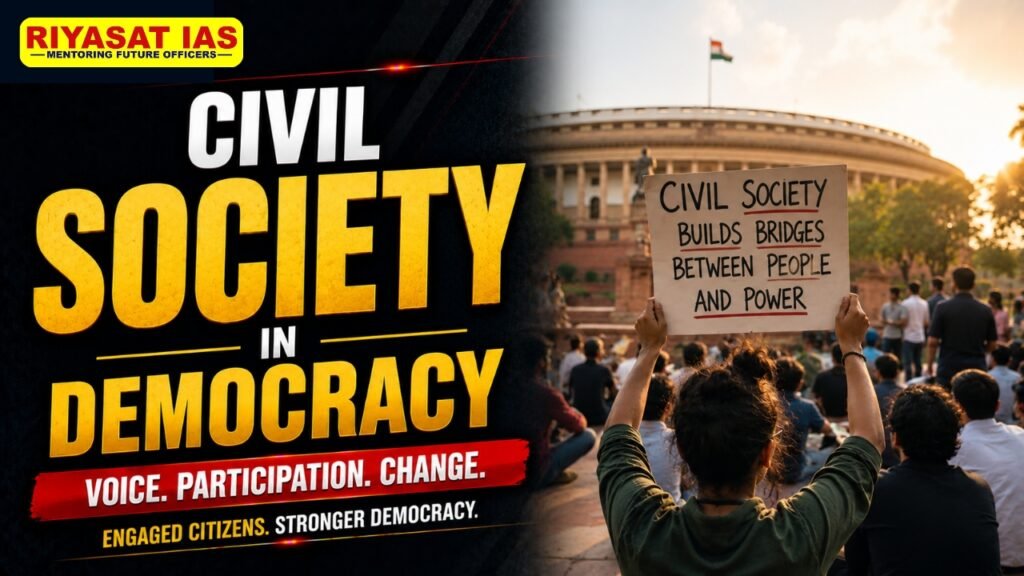
What is Civil Society?
· Civil society refers to the space between the State, market and family where citizens voluntarily organise themselves to pursue common interests, protect rights, provide social services and influence public policy.
· It includes NGOs, voluntary organisations, community groups, trade unions, professional associations, self-help groups, social movements, charitable organisations and advocacy groups.
Civil Society vs Political Society
· Civil society primarily seeks to influence governance and public affairs without directly seeking governmental power, whereas political parties primarily seek to acquire and exercise political power through elections.
Types of Civil Society Organisations
· NGOs and Voluntary Organisations: These work on areas such as education, health, poverty alleviation, environment and human rights. For examples: SEWA, PRS Legislative Research and HelpAge India.
· Community-Based Organisations: These are locally organised groups that address community-level issues. For examples: Village committees, resident welfare associations and community groups.
· Social Movements: They mobilise citizens around particular social, environmental or rights-based issues. For examples: Chipko Movement, Narmada Bachao Andolan and the Right to Information movement.
· Trade Unions and Workers’ Organisations: They represent the interests and rights of workers.
· Professional Associations: Bodies representing professions such as lawyers, doctors, teachers and engineers can contribute to policy discussions and professional standards.
· Religious and Charitable Organisations: They provide education, healthcare, relief and social welfare, while also contributing to community mobilisation.
· Self-Help Groups and Cooperatives: They promote financial inclusion, livelihoods, collective action and women’s empowerment.
· Think Tanks and Advocacy Organisations: They conduct research, generate evidence and influence public policy.
Evolution of Civil Society in India
Ancient India
o Indian society had traditions of collective decision-making, community institutions and voluntary social action.
o Institutions such as Sabha, Samiti and village-level assemblies provided spaces for collective deliberation.
o Community-based institutions also played roles in managing common resources, social welfare and local affairs.
Medieval India
o Community institutions continued to function through village communities, guild-like organisations and religious and charitable institutions.
o Institutions associated with different religious traditions contributed to education, charity, community welfare and social support.
Colonial Period
Modern civil society organisations expanded significantly during British rule.
o Growth of social and religious reform movements.
o Emergence of modern voluntary associations.
o Expansion of newspapers and public debate.
o Formation of political and professional associations.
o Development of organised movements against colonial rule.
o Examples: Brahmo Samaj, Arya Samaj, Aligarh Movement, Prarthana Samaj, Ramakrishna Mission
· These organisations addressed issues such as social reform, education, women’s status and caste inequalities.
· The freedom movement further transformed civil society into a major instrument of mass mobilisation and political consciousness.
Civil Society After Independence
· 1950s–1970s: Welfare and Development Orientation: Civil society organisations largely focused on community development, rural development, education, health and welfare.
· 1970s–1980s: Rights and Social Movements: Civil society became increasingly involved in movements concerning environment, land and displacement, women’s rights, tribal rights, human rights, poverty and livelihoods, with examples including the Chipko Movement and Narmada Bachao Andolan.



· 1990s: Expansion of NGOs: Economic liberalisation, international development assistance and greater public participation contributed to the expansion and professionalisation of NGOs.
· 2000s: Rights-Based Civil Society: Civil society played an important role in campaigns for the Right to Information, the Right to Education, forest rights, social audits, food security, transparency and accountability.
o The RTI movement, particularly the work of the Mazdoor Kisan Shakti Sangathan (MKSS), demonstrated how grassroots mobilisation could lead to major institutional reforms.
· 2010s–Present: Digital and Networked Civil Society: Civil society increasingly operates through social media, crowdfunding, digital campaigns, online petitions and data-driven advocacy.
o This has made mobilisation faster and geographically wider, while also creating challenges involving misinformation, online polarisation and digital surveillance.
Regulatory Framework
· Societies Registration Act, 1860: It provides a legal framework for registering certain societies formed for charitable, literary, scientific and social purposes.
· Indian Trusts Act, 1882: It provides a framework for certain private trusts, although many public charitable trusts are governed by State-specific laws.
· Companies Act, 2013: Section 8 companies can be established for charitable and other socially beneficial purposes without distributing profits among members.
· Foreign Contribution Regulation Act, 2010: The FCRA regulates the acceptance and utilisation of foreign contributions by specified individuals, associations and organisations. Its objective is to ensure that foreign contributions do not adversely affect national interest, sovereignty and integrity.
· Income Tax Act: Eligible charitable organisations can obtain tax exemptions subject to prescribed conditions, helping support their social and charitable activities.
· Right to Information Act, 2005: RTI enables citizens and civil society organisations to obtain information from public authorities, strengthening their role in social accountability and transparency.
· CSR Framework: The Companies Act, 2013 created a statutory framework for Corporate Social Responsibility (CSR) for qualifying companies. Civil society organisations can partner with companies in implementing eligible CSR activities.
Role of Civil Society in Democracy
· Promotes Citizen Participation: Civil society provides citizens with avenues to participate in public affairs beyond periodic elections. Civil society transforms citizens from voters into active participants in governance.
· Acts as a Watchdog: Civil society organisations monitor government policies and expose corruption, rights violations, administrative failures, environmental damage and misuse of public resources.
· Strengthens Accountability: Through RTI, social audits, public hearings, citizen report cards and public campaigns, civil society can hold public institutions accountable.
· Protects Rights: Civil society organisations advocate for the rights of women, children, persons with disabilities, tribal communities, minorities, workers and other marginalised groups.
· Acts as a Bridge Between State and Citizens: Civil society communicates citizens’ needs and grievances to government while helping communities understand and access government programmes.
· Promotes Policy Innovation: NGOs and think tanks often develop pilot projects, research-based solutions and alternative policy approaches that can later be adopted by governments.
· Provides Social Services: Civil society organisations supplement government efforts in education, healthcare, disaster relief, livelihoods, skill development and rehabilitation.
· Strengthens Social Capital: Collective action builds trust, cooperation, solidarity and community networks, strengthening the foundations of democratic society.
· Promotes Social Reform: Civil society has historically contributed to campaigns against caste discrimination, gender inequality, child marriage, untouchability and other social injustices.
· Strengthens Electoral Democracy: Civil society organisations can promote voter awareness, candidate information, electoral literacy, election monitoring and campaign-finance transparency.
Challenges Facing Civil Society
· Regulatory Constraints: Complex compliance requirements can increase the administrative burden on smaller organisations.
· Funding Constraints: Dependence on donations, grants or foreign contributions can create financial uncertainty.
· Accountability Concerns: Not all NGOs maintain adequate standards of financial transparency, governance and impact reporting.
· Political Polarisation: Some civil society organisations may become closely aligned with particular political or ideological interests, affecting their perceived neutrality.
· Foreign Funding Concerns: Foreign contributions can raise concerns about national security, transparency and foreign influence, requiring appropriate regulation.
· Elite Capture: Some organisations may not genuinely represent the communities they claim to represent.
· Capacity Constraints: Smaller grassroots organisations may lack professional staff, financial resources, technology, research capacity and monitoring systems.
· Shrinking Civic Space: Excessive restrictions on peaceful association, expression or public participation can weaken the ability of civil society to perform its democratic watchdog role.
· Digital Misinformation: Online mobilisation can spread misinformation rapidly and sometimes lead to polarisation and social conflict.
· Urban-Rural Divide: Professional NGOs and advocacy networks are often concentrated in urban areas, while many rural and remote communities remain underrepresented.
Way Forward
· Maintain a Balance Between Regulation and Civic Freedom: Regulation should ensure financial integrity and national security without unnecessarily restricting legitimate civil society activity.
· Improve Regulatory Transparency: Registration, FCRA compliance and other regulatory processes should be predictable, transparent, digital and time-bound.
· Strengthen Self-Regulation: Civil society organisations should adopt stronger standards of financial disclosure, internal governance, impact assessment and conflict-of-interest management.
· Promote State–Civil Society Partnerships: Government should involve credible civil society organisations in policy design, service delivery, social audits and disaster management.
· Support Grassroots Organisations: Small community-based organisations should receive greater access to capacity building, technology and institutional support.
· Strengthen Social Accountability: Mechanisms such as social audits, public hearings, RTI and citizen report cards should be institutionalised.
· Promote Evidence-Based Advocacy: Civil society organisations should increasingly use data, research and measurable outcomes to influence public policy.
· Strengthen Digital Civic Space: Digital platforms should enable peaceful participation while addressing misinformation, hate speech and online harassment through proportionate regulation.
· Protect Whistleblowers and Human-Rights Defenders: People who expose corruption or rights violations should receive appropriate legal and institutional protection.
Conclusion
A vibrant civil society is essential for a healthy democracy because it connects citizens with the State, scrutinises public power, protects rights and enables collective action. India should therefore pursue a balanced approach in which the State ensures transparency, financial accountability and national security while protecting the constitutional freedoms of association, expression and peaceful participation.
“A strong State and a strong civil society are not mutually exclusive; democratic governance is strengthened when both remain accountable, autonomous and responsive to citizens.”
FAQs
1. What is civil society?
Ans: Civil society comprises voluntary, autonomous organisations and collective associations operating between the State, market and family to pursue social and public interests.
2. How does civil society strengthen democracy?
Ans: It strengthens democracy by promoting citizen participation, government accountability, rights protection, public debate and social mobilisation.
3. What is the main legal framework regulating NGOs receiving foreign contributions?
Ans: The Foreign Contribution Regulation Act, 2010 (FCRA) regulates the acceptance and utilisation of foreign contributions by specified organisations.
4. Give an example of civil society influencing institutional reform in India.
Ans: The MKSS-led grassroots RTI movement used public hearings and access to government records to build demand for greater transparency, contributing to the enactment of the RTI Act, 2005.
5. What is the major challenge in regulating civil society?
Ans: The key challenge is to balance financial and institutional accountability with the constitutional freedom of association, expression and peaceful civic participation.


 Ravi Raaz
 Hassan Khan
 Shadab Ali