
Introduction
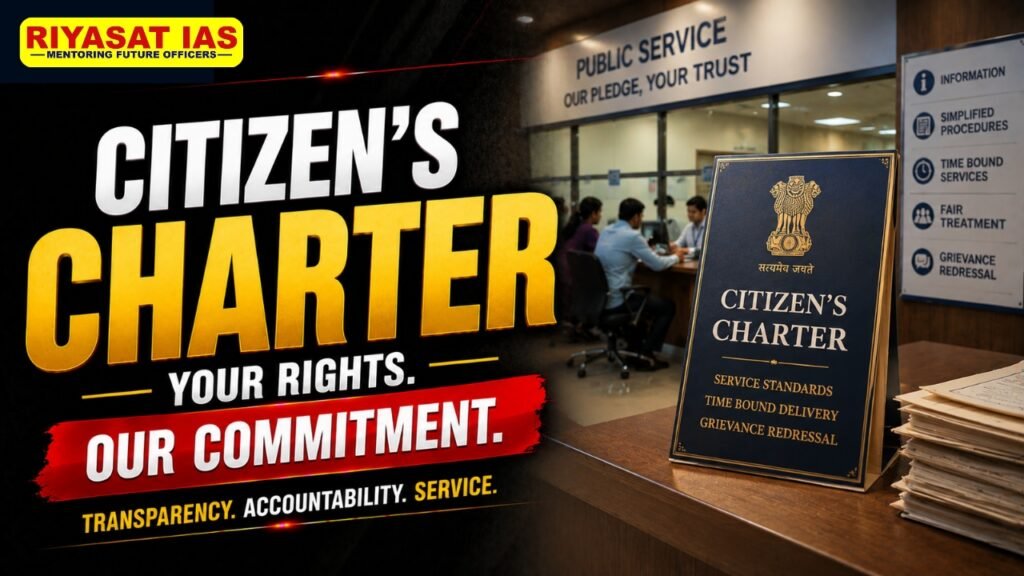
· A Citizen’s Charter is a public declaration by a government department or public service organisation specifying the services it provides, service standards, time limits, citizens’ rights, grievance-redressal mechanisms and responsibilities of service providers.
· It represents a shift from department-centric administration to citizen-centric governance by making public authorities more transparent, responsive and accountable.
Background and Evolution in India
- The concept of the Citizen’s Charter originated in the United Kingdom in 1991 under the government of John Major.
- India adopted the concept in 1997, following the Chief Ministers’ Conference on Effective and Responsive Administration.
- The conference emphasised making administration more transparent, accountable and responsive to citizens.
- The Department of Administrative Reforms and Public Grievances (DARPG) became the nodal agency for promoting Citizen’s Charters across government departments.
- The 2nd Administrative Reforms Commission (ARC) subsequently examined the weaknesses of Citizen’s Charters and suggested reforms to make them more effective.
Salient Features
· Clear Statement of Services: The Charter should clearly identify the services provided by the organisation.
· Service Standards: It should specify measurable standards regarding quality, time and reliability of service delivery.
· Time-Bound Delivery: Citizens should know within how much time a particular service will be delivered.
· Transparency: The Charter should provide citizens with information about procedures, requirements, fees and responsible officials.
· Grievance Redressal: It should specify the mechanism through which citizens can complain about delay, denial or poor-quality service.
· Accountability: The Charter identifies the authority responsible for delivering the service, making it easier to fix responsibility for failure.
· Citizen Participation: Citizens should be consulted while designing and periodically revising the Charter.
· Accessibility: Charters should be available in simple language and accessible formats, particularly for vulnerable groups.
· Continuous Improvement: Service standards should be periodically reviewed based on citizen feedback and performance data.
Importance of Citizen’s Charter
· Promotes Citizen-Centric Governance: It changes the relationship between citizens and government from beneficiary–authority to service provider–citizen.
· Enhances Accountability: Clearly defined service standards make it easier to identify which authority is responsible for delay or failure.
· Improves Transparency: Citizens receive information about procedures, documents, fees and timelines, reducing information asymmetry.
· Reduces Corruption: Clear procedures and time limits can reduce arbitrary discretion, repeated visits and opportunities for petty corruption.
· Improves Service Delivery: Defined standards encourage departments to monitor their own performance and improve efficiency and responsiveness.
· Empowers Citizens: Citizens become aware of their rights and entitlements and can demand services according to declared standards.
· Strengthens Trust in Government: Predictable and responsive service delivery improves citizen confidence in public institutions.



Implementation of Citizen’s Charter in India
The Government of India has promoted Citizen’s Charters across Central Government departments, States and public-sector organisations.
Implementation Framework: A department generally identifies:
- Services provided
- Service standards
- Time limits
- Responsible officials
- Grievance-redressal mechanism
- Citizens’ responsibilities
- Review mechanism
DARPG
· The Department of Administrative Reforms and Public Grievances (DARPG) acts as the nodal agency for promoting and coordinating Citizen’s Charter initiatives.
Sevottam Model
The Government developed the Sevottam framework as a quality-management framework for improving public-service delivery. It focuses on three major components:
- Citizen’s Charter
- Grievance Redressal Mechanism
- Service Delivery Capability
Sevottam seeks to convert the Citizen’s Charter from a declaration of intentions into a system for measurable service delivery improvement.
Problems in Implementation
· Charters Are Often Non-Binding: Many Citizen’s Charters do not create a strong legal entitlement to timely service, reducing their enforceability.
· Poor Awareness: Citizens often do not know that a department has a Charter or what service standards and grievance mechanisms it provides.
· Vague Commitments: Some Charters use broad statements such as “prompt service” without specifying measurable timelines or quality indicators.
· Lack of Citizen Consultation: Charters are sometimes prepared by departments without adequately consulting the actual users of public services.
· Unrealistic Standards: Some departments announce ambitious standards without ensuring adequate staff, infrastructure and financial resources.
· Weak Grievance Redressal: Failure to provide an effective and independent grievance mechanism reduces the Charter’s usefulness.
· Lack of Accountability: Officials may not face meaningful consequences when declared service standards are not met.
· Department-Centric Approach: In some cases, the Charter becomes merely a formal document displayed on a website or office wall rather than an instrument of administrative reform.
Important Government and Bureaucratic Initiatives
· Sevottam: The Sevottam framework was developed by DARPG to improve the quality of public service delivery through an integrated approach involving:
· CPGRAMS: The Centralised Public Grievance Redress and Monitoring System (CPGRAMS) provides citizens with an online mechanism to lodge and track grievances relating to government departments. It strengthens the grievance-redressal component of citizen-centric governance.
· Right to Information Act, 2005: RTI strengthens the transparency dimension of Citizen’s Charters by enabling citizens to seek information about government decisions, records and service delivery.
· Digital India and e-Governance: Digital platforms such as UMANG, DigiLocker, e-District services and Common Service Centres reduce physical interfaces and make government services more accessible.
· Mission Karmayogi: The National Programme for Civil Services Capacity Building – Mission Karmayogi seeks to develop a more professional, citizen-centric and competency-driven civil service.
· Social Accountability Mechanisms: Tools such as social audits, public hearings and citizen feedback mechanisms enable citizens to evaluate whether public services actually meet declared standards.
2nd Administrative Reforms Commission Recommendations
The 2nd ARC’s 12th Report, “Citizen Centric Administration – The Heart of Governance”, made important recommendations for strengthening Citizen’s Charters.
· Make Charters Effective: Citizen’s Charters should not remain merely declarations of intent; they should become instruments of measurable improvement in service delivery.
· One Size Does Not Fit All: Charters should be organisation-specific and service-specific, reflecting the actual needs and expectations of citizens.
· Citizen Participation: Citizens and stakeholders should be actively involved in formulating and revising Charters.
· Clearly Define Standards: Service standards should be specific, measurable and realistic.
· Fix Responsibility: The Charter should clearly identify the official responsible for delivering each service.
· Strengthen Grievance Redressal: Every Charter should have an effective grievance-redressal mechanism, with clearly defined responsibility and timelines.
· Periodic Review: Charters should be regularly reviewed and updated based on citizen feedback and changing circumstances.
· Independent Assessment: The performance of departments against their Charter commitments should be independently evaluated.
· Wider Awareness: Citizens should be made aware of the Charter through publicity, simple language and accessible formats.
Way Forward
· Move from Charter to Legal Entitlement: Important public services should increasingly be covered under legally enforceable Right to Public Services frameworks.
· Use Real-Time Dashboards: Departments should publicly display service-delivery indicators such as applications received, services delivered on time, delays and grievances resolved.
· Strengthen Citizen Feedback: Citizen satisfaction surveys, feedback mechanisms and social audits should be systematically integrated into Charter review.
· Link Accountability with Performance: Repeated failure to meet declared standards should trigger corrective action and managerial accountability.
· Ensure Accessibility: Charters should be available in regional languages, simple language and accessible digital and physical formats.
· Adopt a Citizen-Centric Design: Services should be redesigned around the citizen’s journey, reducing unnecessary documents, visits, approvals and waiting time.
Conclusion
The Citizen’s Charter represents an important transition from authority-driven administration to citizen-centric governance. Its effectiveness, however, depends on moving beyond symbolic declarations towards measurable standards, enforceable service rights, effective grievance redressal, citizen participation and performance-based accountability.
“A Citizen’s Charter becomes meaningful only when a citizen can not only know the promised service standard but also demand accountability when that standard is not met.”
FAQs
Q1. What is a Citizen Charter?
Ans: A Citizen Charter is a document that specifies the services provided by a public authority, service standards, timelines and citizens’ grievance-redressal mechanisms.
Q2. What are the main objectives of a Citizen Charter?
Ans: Its main objectives are to promote transparency, accountability, responsiveness, quality service delivery and citizen participation in governance.
Q3. What are the key components of a Citizen Charter?
Ans: Its key components include service standards, time limits, information about service providers, citizens’ rights and responsibilities, and grievance-redressal mechanisms.
Q4. What are the major challenges in implementing Citizen Charters in India?
Ans: Major challenges include lack of awareness, vague service standards, inadequate monitoring, weak grievance-redressal mechanisms and limited accountability for non-compliance.
Q5. How can Citizen Charters be made more effective?
Ans: Citizen Charters should have measurable service standards, legally backed accountability, regular performance audits, citizen feedback and time-bound grievance redressal.


 Ravi Raaz
 Hassan Khan
 Shadab Ali