
GS-III: Agriculture | Women in Agriculture | Agrifood Systems | Inclusive Growth | Food Processing | Land Rights
Context
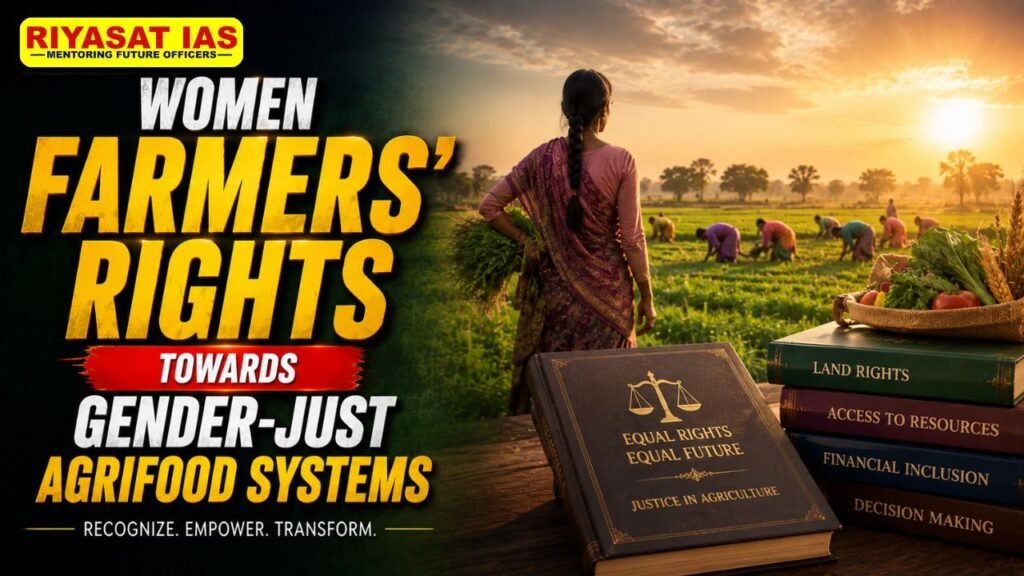
- Centre considering separate legislation for women farmers: The Union government is considering legislation to protect and strengthen the rights of women farmers, along the lines of the Maharashtra Women Farmers Empowerment Act, 2026.
- Maharashtra legislation seen as a landmark initiative: S. Mahendra Dev, Chairman of the Economic Advisory Council to the Prime Minister, described the Maharashtra law as a model that other States could draw inspiration from.
- Need to place women at the centre of agrifood systems: The discussion emphasised the need to move towards gender-just food, land and water systems and recognise women’s contribution to agriculture.
Women are central to India’s agricultural economy
- Women play a critical role in agriculture: Women contribute significantly to agricultural and allied activities, making their recognition as farmers essential for an inclusive agrarian economy.
- Policy recognition remains important: Legal and institutional measures can help ensure that women farmers receive appropriate recognition and support.
- Gender equality strengthens agrifood systems: Placing women at the centre of food and agricultural systems can improve the inclusiveness and sustainability of rural development.
Maharashtra Women Farmers Empowerment Act, 2026 provides a potential model
- Landmark legislation: The Maharashtra law has been described as a significant step towards recognising and empowering women farmers through dedicated policy measures.
- Potential model for other States: The legislation could provide a framework for other States seeking to strengthen the rights and economic position of women engaged in agriculture.
- Political consensus: The legislation reportedly received support across party lines when introduced in the Maharashtra Assembly, indicating wider recognition of the issue.



Need to shift agriculture from production-centric to income-centric
- Focus on farmers’ incomes: Agriculture policy should move beyond simply increasing production towards improving the income and economic security of farmers.
- Crop diversification can improve returns: Diversification can provide farmers with alternative income opportunities and reduce excessive dependence on a limited number of crops.
- Post-harvest marketing is crucial: Better marketing mechanisms can help farmers capture greater value from their produce.
- Food and agro-processing can enhance value addition: Processing agricultural products can generate additional income and create rural employment.
- Institutional support is essential: Stronger institutions and support mechanisms can enable women farmers to participate more effectively in agricultural value chains.
Why women-centric agricultural policy matters
- Recognises women as farmers rather than merely agricultural workers: Dedicated policies can improve the visibility and recognition of women’s contribution to agriculture.
- Promotes economic empowerment: Better access to institutional support and agricultural value chains can strengthen women’s economic position.
- Strengthens inclusive growth: Empowering women farmers can contribute to more equitable rural development.
- Supports gender-just agrifood systems: Policies centred on women can help address gender inequalities in access to agricultural resources and opportunities.
Significance
- Strengthens women’s economic agency: Legal recognition can enable women to participate more meaningfully in agricultural decision-making and economic activities.
- Promotes income-oriented agriculture: The approach links gender empowerment with broader agricultural transformation.
- Encourages value-chain participation: Greater involvement in processing, marketing and diversification can help women move beyond low-value agricultural activities.
- Supports rural development: Women-centred agricultural policies can contribute to stronger and more inclusive rural economies.
Challenges
- Recognition of women as farmers: Women involved in agriculture may not always receive formal recognition as farmers.
- Limited access to institutional support: Effective empowerment requires access to agricultural services, markets and other forms of institutional assistance.
- Low participation in higher-value activities: Women may remain concentrated in lower-value segments of agricultural production.
- Need for effective implementation: Legislation alone may not ensure empowerment unless supported by appropriate institutions and implementation mechanisms.
Way Forward
- Strengthen legal recognition of women farmers: Dedicated legislation can provide a stronger policy framework for recognising and protecting their interests.
- Promote crop diversification: Encourage diversified agricultural systems that can improve farm incomes.
- Expand post-harvest and agro-processing opportunities: Enable women farmers to participate in higher-value segments of the agricultural value chain.
- Strengthen institutional support: Improve access to agricultural services, markets and income-enhancing opportunities.
- Adopt an income-centric approach: Agricultural policy should focus not only on production but also on value addition, marketing and farmer incomes.
Conclusion
Recognising women as farmers, entrepreneurs and key participants in agrifood systems is essential for achieving inclusive agricultural transformation. The proposed central legislation, inspired by Maharashtra’s initiative, could provide an important framework for strengthening women’s rights and economic opportunities. A shift from production-centric to income-centric agriculture, supported by diversification, processing, marketing and institutions, can make India’s agrifood system more gender-just and economically sustainable.
UPSC Mains Practice Question
Q. Women play a crucial yet inadequately recognised role in India’s agricultural economy. Discuss the need for a dedicated policy and legislative framework for women farmers and suggest measures to make India’s agrifood system more gender-just and income-centric.



 Ravi Raaz
 Hassan Khan
 Shadab Ali