
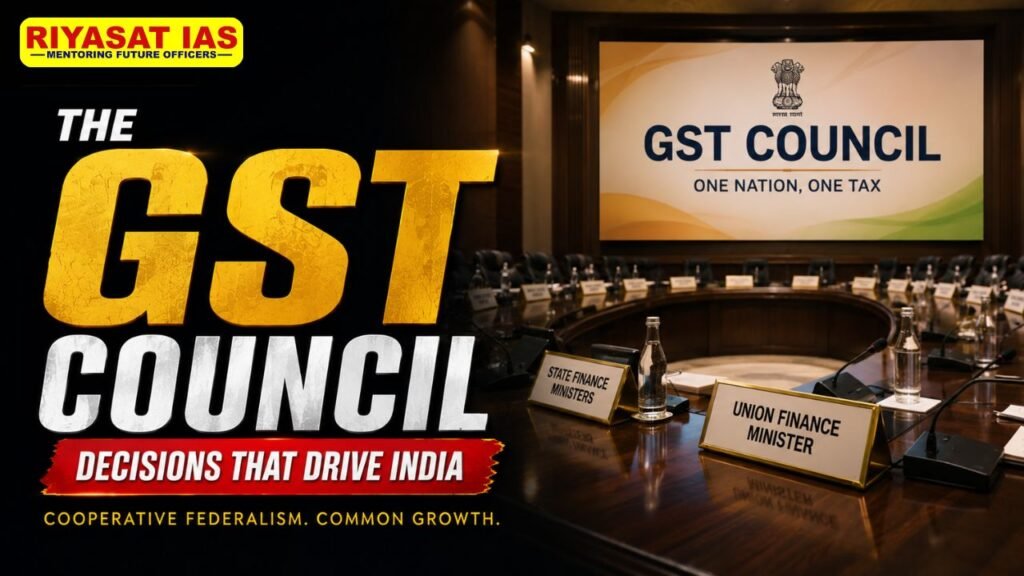
What is GST?
The Goods and Services Tax (GST) is a destination-based, value-added indirect tax levied on the supply of goods and services. Introduced on 1 July 2017, it replaced multiple Central and State indirect taxes such as Excise Duty, Service Tax, Value Added Tax (VAT), Entry Tax, and Luxury Tax with a unified tax system.
GST follows the principle of “One Nation, One Tax” and allows seamless Input Tax Credit (ITC) to reduce the cascading effect of taxation.
What is the GST Council?
The GST Council is a constitutional body established under Article 279A of the Constitution. It is the highest decision-making forum on matters related to Goods and Services Tax in India. The Council recommends tax rates, exemptions, threshold limits, model GST laws, and other policy measures to ensure uniform implementation of GST across the country while promoting cooperative federalism.
Background
Before the introduction of GST, India’s indirect taxation system was fragmented, with separate taxes imposed by the Centre and the States. This often resulted in tax-on-tax (cascading effect), multiple compliances, and barriers to inter-State trade. To overcome these challenges and establish a unified national market, the 101st Constitutional Amendment Act, 2016 introduced the GST regime and created the GST Council as a constitutional body to ensure coordination between the Union and the States in matters related to GST.
Constitutional Provisions
The GST Council derives its constitutional status from Article 279A, which was inserted through the 101st Constitutional Amendment Act, 2016. The Article mandates the President of India to constitute the Council within 60 days of the commencement of the Amendment Act.
The GST Council recommends key GST-related matters, including tax rates, exemptions, threshold limits, special provisions for States, and dispute resolution mechanisms. Although its recommendations carry significant persuasive value, the Supreme Court, in Union of India v. Mohit Minerals Pvt. Ltd. (2022), held that neither Parliament nor the State Legislatures are legally bound by them.
Composition
The GST Council consists of representatives from both the Union and the States, ensuring balanced participation in tax policy formulation.
- Chairperson: Union Finance Minister
- Member: Union Minister of State in charge of Revenue or Finance
- Members: Finance Minister or Taxation Minister of each State and Union Territory with a Legislature
- Vice-Chairperson: Elected by the State representatives from among themselves
Decision-Making
The Council follows a weighted voting system to balance the interests of the Centre and the States.
- Centre’s vote carries one-third (1/3) of the total weight.
- All States together have two-thirds (2/3) of the voting weight.
- A decision requires a 75% weighted majority.
This arrangement ensures that neither the Centre nor the States can take unilateral decisions, thereby encouraging consensus.
Functions of the GST Council



The GST Council serves as the principal policy-making body for India’s GST regime and performs several important functions.
· Recommending GST Rates: The Council recommends tax rates for goods and services, including the applicable tax slabs and exemptions. It also reviews rates periodically to maintain revenue neutrality and address sectoral concerns.
· Formulating GST Laws: It recommends model GST laws, principles governing levy and collection of GST, and procedural reforms to ensure uniform implementation across the country.
· Determining Goods and Services under GST: The Council decides which goods and services should be included within the GST framework. It also recommends the inclusion of petroleum products under GST at an appropriate time.
· Threshold Limits and Composition Scheme: The Council prescribes turnover limits for GST registration and recommends eligibility conditions under the Composition Scheme to reduce compliance burden for small taxpayers.
· Special Provisions for States: It recommends special provisions for North-Eastern, hill, and other special category States, considering their unique geographical and economic conditions.
· Disaster and Emergency Taxation: The Council may recommend special GST rates during natural disasters or emergencies to mobilise additional financial resources.
· Dispute Resolution: It recommends mechanisms to resolve disputes arising between the Centre and the States or among States regarding GST implementation and revenue sharing.
Significance of the GST Council
· Strengthening Cooperative Federalism: The GST Council is regarded as one of the finest examples of cooperative federalism in India. It provides a constitutional platform where the Union and the States jointly deliberate and arrive at consensus-based decisions on indirect taxation, thereby balancing national priorities with State interests.
· Creating a Common National Market: By replacing multiple indirect taxes with a uniform GST structure, the Council has facilitated the free movement of goods and services across State boundaries. This has reduced market fragmentation and promoted economic integration.
· Improving Ease of Doing Business: Uniform tax laws, simplified compliance procedures, and digital filing mechanisms have reduced procedural complexities for businesses operating in multiple States. This has enhanced India’s business environment and reduced transaction costs.
· Reducing Cascading of Taxes: The seamless Input Tax Credit (ITC) mechanism ensures that tax is levied only on the value added at each stage of production and distribution, thereby eliminating the cascading effect of taxation.
· Enhancing Revenue and Transparency: GST has improved tax compliance through digital return filing, e-invoicing, and data-driven administration. These measures have widened the tax base, reduced tax evasion, and increased revenue mobilisation.
· Strengthening Fiscal Federalism: The Council provides States with an institutional platform to participate in tax policy decisions, thereby promoting fiscal cooperation and improving Centre-State financial relations.
Issues Related to the GST Council
· Concerns over Fiscal Autonomy of States: Many States have expressed concerns that the GST framework has reduced their independent taxation powers. Since major decisions are taken through the GST Council, States have limited flexibility in designing their own indirect tax policies.
· Delay in GST Compensation: Several States faced financial stress due to delays in receiving GST compensation, particularly during the COVID-19 pandemic. This highlighted the challenges of revenue dependence under the GST regime.
· Frequent Changes in GST Rates: Repeated revisions in tax rates and exemptions create uncertainty for businesses and increase compliance costs, especially for Micro, Small and Medium Enterprises (MSMEs).
· Complex Compliance Requirements: Although GST simplified the tax structure, businesses—particularly small enterprises—continue to face difficulties in return filing, reconciliation of Input Tax Credit, and compliance with evolving procedures.
· Petroleum Products Outside GST: Major petroleum products remain outside the GST framework, leading to multiple taxation systems and limiting the objective of a truly unified indirect tax regime.
· Non-Binding Nature of Recommendations: The Supreme Court’s 2022 judgment clarified that the recommendations of the GST Council are not binding. While this reinforces constitutional federalism, it may also result in policy divergence if the Centre and States adopt different approaches.
Way Forward
· Deepen Cooperative Federalism: The Centre and the States should continue to strengthen consensus-based decision-making in the GST Council. Regular consultations and greater transparency can enhance mutual trust and improve policy outcomes.
· Rationalise the GST Rate Structure: India should gradually move towards a simpler GST structure with fewer tax slabs. A rationalised rate system would reduce classification disputes, improve compliance, and provide certainty to businesses.
· Simplify GST Compliance: The compliance framework should be made more taxpayer-friendly by simplifying return filing, strengthening the GST portal, and reducing procedural burdens for MSMEs through greater automation.
· Ensure Predictable Revenue Support: A stable mechanism should be developed to address States’ revenue concerns, particularly during periods of economic slowdown. Timely compensation and improved revenue-sharing arrangements would strengthen fiscal federalism.
· Bring Petroleum Products under GST: Petroleum products may be gradually included within the GST framework after building consensus among stakeholders. This would further integrate the indirect tax system and reduce tax cascading.
· Strengthen Dispute Resolution: A robust and institutionalised dispute resolution mechanism should be developed to resolve Centre-State and inter-State disagreements efficiently, ensuring smoother implementation of GST.
Conclusion
The GST Council has emerged as a landmark institution in India’s fiscal architecture by institutionalising cooperative federalism and creating a harmonised indirect tax regime. While challenges relating to fiscal autonomy, compliance, and revenue sharing remain, continued consensus-building, tax rationalisation, and administrative reforms can further strengthen the GST framework and contribute to India’s long-term economic growth.
FAQs
1. What is the GST Council?
The GST Council is a constitutional body under Article 279A that recommends policies related to Goods and Services Tax in India.
2. Which Constitutional Amendment established the GST Council?
The 101st Constitutional Amendment Act, 2016 established the GST Council.
3. Are the recommendations of the GST Council binding?
No, the Supreme Court (Mohit Minerals Case, 2022) held that the GST Council’s recommendations are persuasive but not legally binding.
4. Who is the Chairperson of the GST Council?
The Union Finance Minister is the Chairperson of the GST Council.
5. What is the voting pattern in the GST Council?
The Centre has 1/3 voting weight, the States collectively have 2/3 voting weight, and decisions require a 75% weighted majority.


 Ravi Raaz
 Hassan Khan
 Shadab Ali