
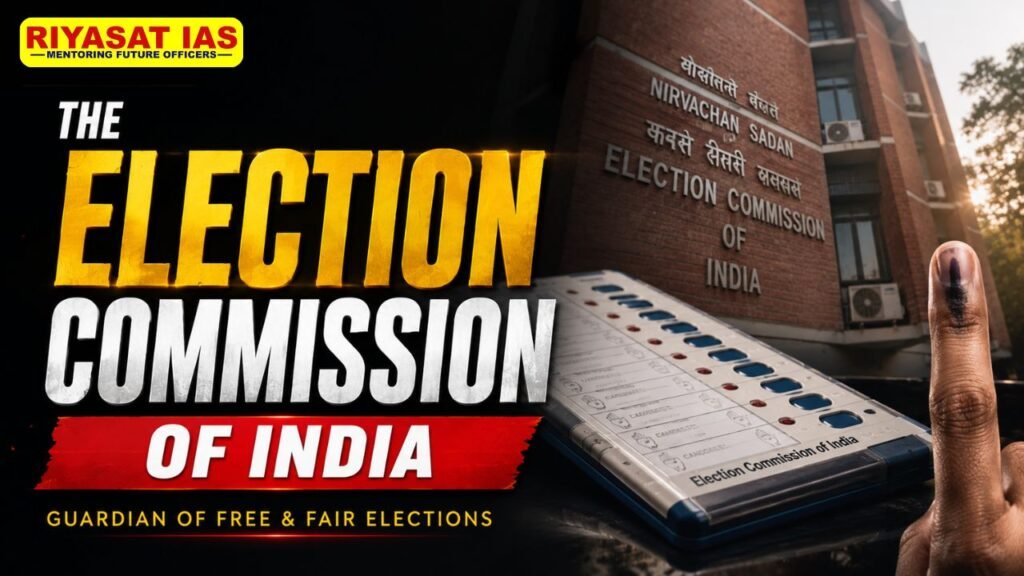
Election Commission of India
About the Election Commission of India
- The Election Commission of India (ECI) is an independent constitutional authority responsible for conducting free, fair, and credible elections in India.
- It conducts elections to the Lok Sabha, Rajya Sabha, State Legislative Assemblies, the offices of the President and Vice-President of India.
- The Commission supervises the preparation of electoral rolls, registration of political parties, recognition of political parties, allotment of election symbols, and enforcement of the Model Code of Conduct.
- The ECI functions under the constitutional mandate of Part XV (Articles 324–329) of the Constitution to safeguard the democratic electoral process.
Constitutional Provisions (Articles 324–329)
· Article 324: Provides for the superintendence, direction, and control of elections to Parliament, State Legislatures, and the offices of the President and Vice-President to be vested in the Election Commission of India.
· Article 325: Provides that there shall be one general electoral roll for every territorial constituency, and no person shall be excluded from it on grounds of religion, race, caste, or sex.
· Article 326: Provides that elections to the Lok Sabha and State Legislative Assemblies shall be based on universal adult suffrage for citizens aged 18 years or above (reduced from 21 years by the 61st Constitutional Amendment Act, 1988).
· Article 327: Empowers Parliament to make laws regarding all matters relating to elections to Parliament and State Legislatures.
· Article 328: Empowers State Legislatures to make laws relating to State elections where Parliament has not made any law.
· Article 329: Bars judicial interference in electoral matters except through an election petition after the completion of the election process.
Structure of the Election Commission of India
- The Election Commission is a multi-member constitutional body consisting of the Chief Election Commissioner (CEC) and such number of Election Commissioners (ECs) as the President may determine.
- Originally, the Commission functioned as a single-member body (1950–1989) headed by the Chief Election Commissioner.
- It became a three-member Commission in 1993, consisting of one Chief Election Commissioner and two Election Commissioners.
- All Commissioners enjoy equal decision-making powers, and decisions are generally taken by majority.
- The Commission is assisted by the Election Commission Secretariat in New Delhi and the Chief Electoral Officers (CEOs), District Election Officers, Returning Officers, and Electoral Registration Officers in the States.
Appointment and Tenure of the Commissioners
Appointment
- Under Article 324(2), the President appoints the Chief Election Commissioner and other Election Commissioners.
- The appointments are governed by the Chief Election Commissioner and Other Election Commissioners (Appointment, Conditions of Service and Term of Office) Act, 2023.
- Under the 2023 Act, appointments are made on the recommendation of a Selection Committee consisting of:
- Prime Minister (Chairperson)
- Union Cabinet Minister nominated by the Prime Minister
- Leader of Opposition in the Lok Sabha (or the leader of the largest opposition party)



Tenure
- The Chief Election Commissioner and Election Commissioners hold office for six years or until attaining the age of 65 years, whichever is earlier.
- They are eligible for the same salary, allowances, and service conditions as those of a Judge of the Supreme Court.
- Their service conditions cannot be varied to their disadvantage after appointment.
Removal of the Commissioners
Chief Election Commissioner (CEC)
- The Chief Election Commissioner can be removed only in the same manner and on the same grounds as a Judge of the Supreme Court.
- Removal requires a special majority of Parliament on the grounds of proved misbehaviour or incapacity, ensuring the independence of the office.
Election Commissioners (ECs)
- Election Commissioners cannot be removed except on the recommendation of the Chief Election Commissioner.
- However, unlike the CEC, the Constitution does not prescribe a parliamentary impeachment process for their removal.
Limitations of the Election Commission of India
- The Constitution does not clearly define the qualifications required for appointment as the CEC or Election Commissioners.
- The appointment process has historically been dominated by the executive, raising concerns regarding institutional independence.
- The Commission has limited powers to enforce the Model Code of Conduct, as it is not a statutory law.
- The ECI has no independent secretariat comparable to the Union Public Service Commission or the Comptroller and Auditor General.
- Delays in electoral reforms, criminalisation of politics, misuse of money power, and the spread of misinformation continue to challenge the Commission’s effectiveness.
- The Commission cannot deregister a political party merely for violating the Model Code of Conduct or failing to contest elections.
Important Supreme Court Judgements
T.N. Seshan v. Union of India (1995)
- The Supreme Court upheld the constitutional validity of the multi-member Election Commission and ruled that the Chief Election Commissioner is “first among equals”, not superior to the other Election Commissioners.
- The Court held that all Election Commissioners enjoy equal powers, and Commission decisions are to be taken collectively.
Anoop Baranwal v. Union of India (2023)
- The Supreme Court directed that, until Parliament enacted a law, the Chief Election Commissioner and Election Commissioners should be appointed by a committee consisting of the Prime Minister, the Leader of Opposition, and the Chief Justice of India.
- Parliament subsequently enacted the Chief Election Commissioner and Other Election Commissioners (Appointment, Conditions of Service and Term of Office) Act, 2023, replacing the Chief Justice of India with a Union Cabinet Minister in the Selection Committee.
Mohinder Singh Gill v. Chief Election Commissioner (1978)
- The Supreme Court held that Article 324 grants the Election Commission broad plenary powers to ensure free and fair elections wherever existing laws are silent, provided such actions are consistent with the Constitution and electoral laws.
Challenges Faced by the Election Commission of India
- Executive Influence in Appointments: The appointment process has raised concerns regarding the institutional independence and perceived neutrality of the Commission.
- Increasing Electoral Malpractices: The growing influence of money power, muscle power, paid news, and criminalisation of politics affects the fairness of elections.
- Weak Enforcement of the Model Code of Conduct (MCC): Since the MCC is non-statutory, the ECI has limited punitive powers against violations.
- Misinformation and Social Media Abuse: The rapid spread of fake news, AI-generated content, deepfakes, and hate speech poses new challenges to electoral integrity.
- Electoral Roll Management: Frequent migration, duplicate entries, deletion of genuine voters, and inaccuracies in electoral rolls remain persistent concerns.
- Low Voter Participation: Urban apathy, migrant workers, overseas Indians, and persons with disabilities continue to face barriers to electoral participation.
- Campaign Finance Transparency: Monitoring political funding, election expenditure, and anonymous donations remains a significant challenge.
- Growing Election Expenditure: Conducting free and fair elections across India’s vast geographical and demographic diversity requires enormous financial and administrative resources.
Technology Integration by the Election Commission
- Electronic Voting Machines (EVMs): EVMs have replaced ballot papers to improve efficiency, reduce invalid votes, and speed up counting.
- Voter Verifiable Paper Audit Trail (VVPAT): VVPAT enables voters to verify their vote and strengthens transparency in the electoral process.
- ERONET: The Electoral Roll Management System digitally manages voter registration and electoral rolls across the country.
- Suvidha Portal: Facilitates online permission requests for election campaign activities by candidates and political parties.
- cVIGIL Mobile App: Allows citizens to report Model Code of Conduct violations in real time with geo-tagged photographs and videos.
- ENCORE Portal: Digitally manages candidate nominations, polling data, counting, and election results.
- National Voters’ Service Portal (NVSP): Provides online voter registration, correction of details, and access to electoral services.
- Electronically Transmitted Postal Ballot System (ETPBS): Enables service voters, particularly armed forces personnel, to cast postal ballots electronically.
Recent Developments
- Chief Election Commissioner and Other Election Commissioners (Appointment, Conditions of Service and Term of Office) Act, 2023: Established a statutory framework for appointing the CEC and Election Commissioners through a Selection Committee.
- Special Intensive Revision (SIR) is a comprehensive exercise conducted by the Election Commission of India (ECI) to prepare an accurate, error-free, and updated electoral roll.
- Digital Campaign Regulation: The ECI has strengthened monitoring of social media platforms, online political advertisements, and election-related misinformation.
- Remote Voting Machine (RVM): The Commission has developed and demonstrated a prototype Remote Voting Machine to facilitate voting by domestic migrant workers.
- Expanded Use of Technology: Greater use of AI-based monitoring, GPS-enabled logistics, webcasting of sensitive polling stations, and digital election management systems.
- Accessible Elections Initiative: The Commission has expanded measures for senior citizens, persons with disabilities (PwDs), and voters above 85 years through home voting and accessible polling stations.
Conclusion
The Election Commission of India is one of the strongest constitutional institutions safeguarding India’s democratic framework through free, fair, and credible elections. Strengthening its institutional independence, enhancing transparency in appointments and political funding, empowering it with stronger statutory enforcement powers, and leveraging secure digital technologies will further reinforce public confidence and the integrity of India’s electoral democracy.


 Ravi Raaz
 Hassan Khan
 Shadab Ali