
GS-III: Environment | Wetlands | Biodiversity Conservation | Environmental Governance
Context
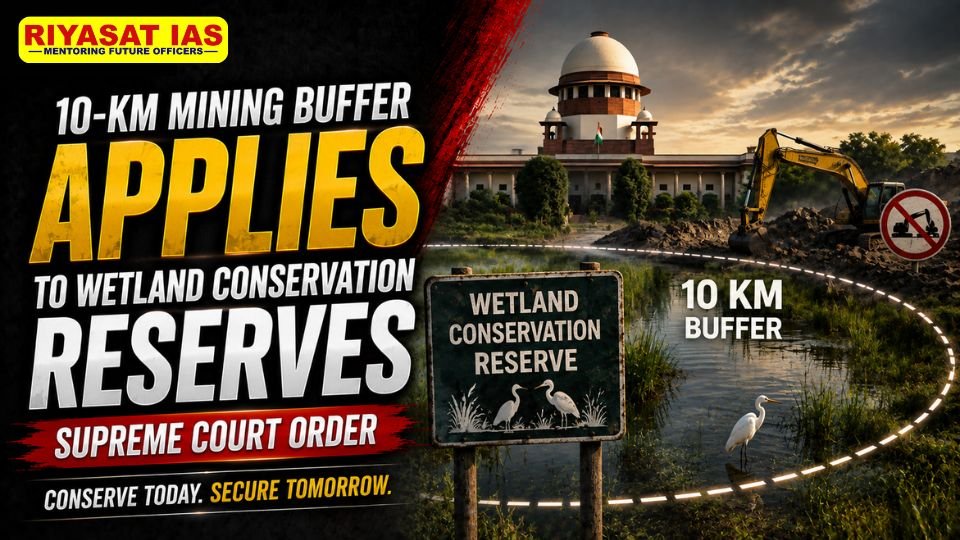
- Supreme Court extends mining safeguard to wetland conservation reserves: The Supreme Court has clarified that its February 2024 direction, requiring prior approval before mining within a 10-km radius of the Asan Wetland Conservation Reserve, would apply to wetland conservation reserves across the country for the sake of parity.
- The clarification extends judicial protection beyond the Asan Ramsar Site: The safeguard, earlier confined to Asan Wetland Conservation Reserve in Uttarakhand, now applies to similarly notified wetland conservation reserves.
Supreme Court clarified the applicability of the Asan Wetland directions
- The clarification arose during the hearing of an application filed by the Himachal Pradesh Government: The State argued that the February 14, 2024 interim order relating to the Asan Wetland should not automatically apply to Himachal Pradesh.
- The State contended that wetland conservation reserves do not have a statutory buffer zone: Unlike National Parks and Wildlife Sanctuaries, no statutory buffer exists around wetland conservation reserves.
- The Bench clarified that the principle is not confined to Uttarakhand: Justice Joymalya Bagchi observed that wherever there is a community reserve or wetland conservation reserve, the Asan directions would apply for the sake of parity.
- The Court directed the NBWL or the MoEFCC to determine whether the Asan Wetland extends into Himachal Pradesh. If it does, the 2024 directions will apply. Otherwise, the authorities will govern mining proposals under the applicable statutory framework.
Background of the Asan Wetland case
- The Asan Wetland Conservation Reserve lies at the confluence of the Asan and Yamuna rivers in Uttarakhand.
- It was designated as a Ramsar Site in 2020: The wetland is an important habitat for migratory waterbirds and aquatic biodiversity.
- The Supreme Court’s interim order dated February 14, 2024, prohibited mining within a 10-km radius unless the Standing Committee of the National Board for Wildlife (NBWL) and/or the Ministry of Environment, Forest and Climate Change (MoEFCC) grants prior approval.
- The Court held that Ramsar status warrants greater scrutiny of activities affecting the ecological character of wetlands.
- The latest clarification extends the same principle to other wetland conservation reserves across India.



Ramsar Sites recognise wetlands of international importance
- Ramsar Sites are designated under the Ramsar Convention on Wetlands: The Convention was adopted at Ramsar, Iran, in 1971.
- The Convention promotes conservation and wise use of wetlands of international importance.
- India became a Contracting Party to the Convention in 1982.
- India currently has 101 Ramsar Sites: Glaw Lake in Arunachal Pradesh became the country’s 101st Ramsar Site and the State’s first on August 3, 2026.
- Ramsar designation does not create a separate statutory protection regime under Indian law: It recognises ecological importance and requires protection through domestic environmental laws.
Legal position regarding mining around Ramsar wetlands
- Neither the Ramsar Convention nor the Wetlands (Conservation and Management) Rules, 2017 prescribe a statutory buffer around Ramsar Sites.
- The 2010 Wetlands Rules contained an explicit list of prohibited activities: These included reclamation, establishment of new industries, dumping of solid waste and activities likely to adversely affect wetlands.
- The 2010 Rules also required prior approval and Environmental Impact Assessment (EIA) for specified activities.
- The 2017 Rules replaced this framework with a decentralised system under State Wetland Authorities.
- The explicit list of prohibited activities was removed: Responsibility for identifying and regulating wetlands was shifted largely to the States.
- The constitutional validity of the 2017 Rules is under challenge before the Supreme Court: Petitioners argue that the Rules weaken protections available under the 2010 framework.
- The Asan directions provide an additional judicial safeguard by requiring wildlife clearance before any mining activity within 10 km of wetland conservation reserves.
Mining around protected areas is governed by separate legal provisions
- Mining is prohibited within National Parks and Wildlife Sanctuaries under the Wildlife (Protection) Act, 1972.
- The Supreme Court has prohibited mining within one kilometre of every National Park and Wildlife Sanctuary: Where a larger Eco-Sensitive Zone (ESZ) has been notified, the larger buffer prevails.
- Projects affecting wildlife habitats require scrutiny by the Standing Committee of the National Board for Wildlife.
- Diversion of forest land for mining requires prior approval under the Van (Sanrakshan Evam Samvardhan) Adhiniyam, 1980.
- Mining projects are generally subject to Environmental Clearance under the Environment Impact Assessment (EIA) Notification, 2006.
Significance
- Extends judicial protection to wetland conservation reserves across the country.
- Provides an additional safeguard against mining activities near ecologically sensitive wetlands.
- Strengthens conservation of Ramsar wetlands and associated biodiversity.
Challenges
- The Wetlands (Conservation and Management) Rules, 2017 do not prescribe a statutory buffer around Ramsar Sites.
- The constitutional validity of the 2017 Rules remains under judicial consideration.
- Protection of wetlands depends on implementation of domestic environmental laws and judicial directions.
Way Forward
- Ensure effective implementation of the Supreme Court’s directions regarding mining near wetland conservation reserves.
- Strengthen protection of wetlands through effective regulatory mechanisms.
- Ensure ecological character of Ramsar Sites is maintained through coordinated action by States and the Union Government.
Conclusion
- The Supreme Court’s clarification strengthens judicial protection for wetland conservation reserves by extending the 10-km mining safeguard across the country. The decision reinforces the importance of conserving ecologically significant wetlands while ensuring that mining activities are subject to greater environmental scrutiny.
UPSC Mains Practice Question
Q. Discuss the significance of the Supreme Court’s directions regarding mining around wetland conservation reserves. Examine the legal framework governing the protection of Ramsar wetlands in India.





 Ravi Raaz
 Hassan Khan
 Shadab Ali