
Introduction
Municipalities are Urban Local Bodies (ULBs) established to ensure democratic decentralization, local self-governance, and efficient urban administration. They provide essential civic services such as water supply, sanitation, solid waste management, urban planning, roads, public health, and local economic development.
Although municipalities existed in India during the colonial period, they received constitutional status only through the 74th Constitutional Amendment Act, 1992, which inserted Part IXA (Articles 243P–243ZG) and the Twelfth Schedule into the Constitution.
Evolution of Municipalities in India
A. Municipal Administration during the British Era
- Lord Mayo’s Resolution (1870): It introduced financial decentralisation and encouraged local bodies to provide civic services through locally raised revenues.
- Lord Ripon’s Resolution (1882): Known as the Magna Carta of Local Self-Government, it promoted elected non-official majorities, local autonomy and democratic participation in municipal administration.
- Royal Commission on Decentralisation (1907): It recommended strengthening local bodies by granting them greater administrative and financial powers.
- Government of India Act, 1919: It transferred local self-government to provincial governments as a transferred subject and increased their responsibility for municipal administration.
- Government of India Act, 1935: It placed local government entirely in the Provincial List and empowered provinces to enact their own municipal laws.
B. Post-Independence Evolution
- Constitution of India (1950): Local government was placed in the State List under Entry 5 of List II, leaving municipalities as statutory bodies governed by state laws.
- Community Development and Urbanisation: Rapid urbanisation exposed municipal weaknesses such as inadequate finances, political interference, weak infrastructure and irregular elections.
- Rural–Urban Relationship Committee (1966): It recommended integrated rural–urban planning and the strengthening of municipal institutions.
- National Commission on Urbanisation (1988): It recommended constitutional recognition, regular elections, financial empowerment and effective metropolitan planning for municipalities.
Important Committees
Rural-Urban Relationship Committee (1966): Recommended integrated urban planning and stronger municipal institutions.
National Commission on Urbanisation (1988)
- Recommended constitutional recognition of municipalities.
- Suggested regular elections, financial strengthening, and metropolitan planning.
74th Constitutional Amendment Act, 1992
- Came into force on 1 June 1993.
- Granted constitutional status to Urban Local Bodies.
- Inserted Part IXA (Articles 243P–243ZG).
- Added the Twelfth Schedule containing 18 functional subjects.
Constitutional Provisions (Part IXA)
Constitutional Framework
- Part IXA: Articles 243P to 243ZG
- Twelfth Schedule: 18 subjects
- 74th Constitutional Amendment Act, 1992
Structure of Urban Local Government in India
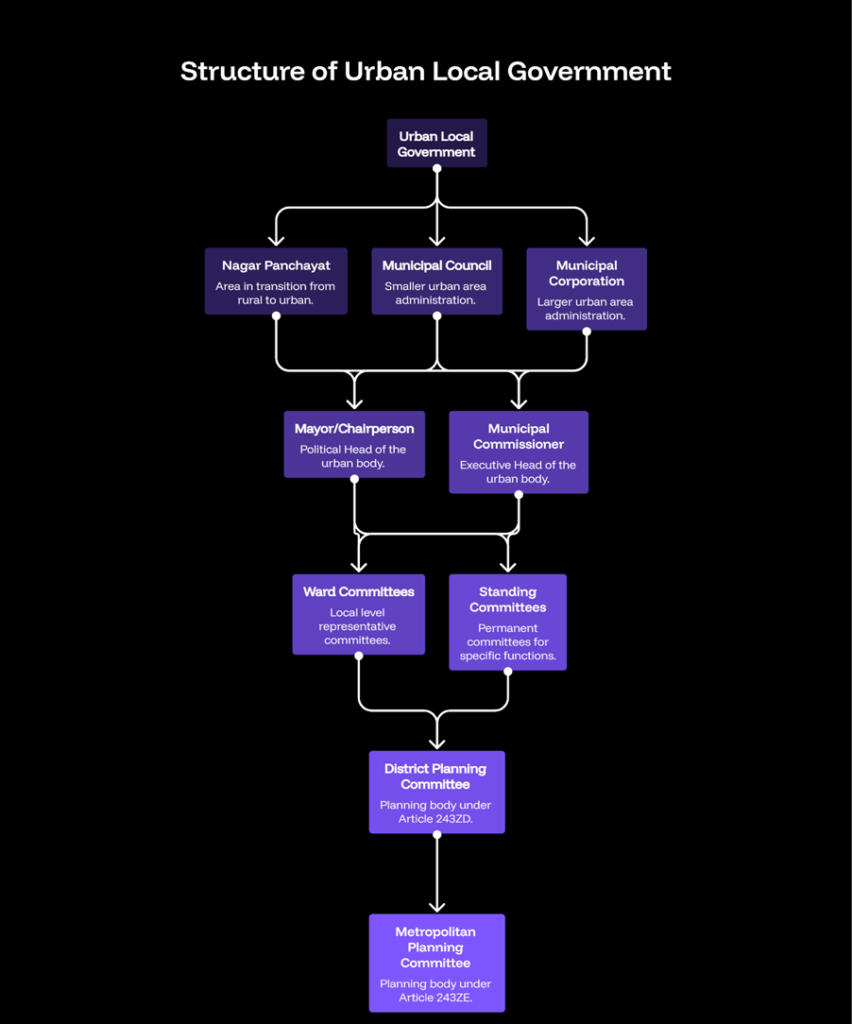
Urban Local Government in India is organized as a three-tier system based on the size, population, and level of urbanization of an area. Under Article 243Q of the Constitution, States constitute different types of municipalities.
| Urban Local Body | Key Features |
| Municipal Corporation (Nagar Nigam) | Established for large cities; provides a wide range of civic services and enjoys comparatively greater administrative and financial powers. Such as Bangalore, Delhi, Mumbai, Kolkata, etc. |
| Municipal Council (Nagar Palika) | Constituted for medium-sized towns; responsible for urban planning, sanitation, water supply, roads, and public health. |
| Nagar Panchayat | Established for transitional areas that are evolving from rural to urban settlements. |
| Notified Area Committee (NAC) | Created by the State Government for rapidly developing or newly urbanized areas where a municipality has not yet been constituted. Members are generally nominated by the State Government. |
| Town Area Committee (TAC) | Constituted for small towns to perform limited civic functions such as sanitation, street lighting, drainage, and roads. |
| Cantonment Board | Established under the Cantonments Act, 2006 to administer civil areas within military cantonments. It functions under the administrative control of the Ministry of Defence. |
| Township | Established in industrial, mining, or project areas where civic services are provided by public sector undertakings or large industries instead of a municipality. |
| Port Trust | Constituted under parliamentary legislation to administer major port areas and provide municipal services within port limits while managing port operations. |



Organizational Structure of a Municipality
Municipal Council/Corporation
- The deliberative body consisting of directly elected councillors from territorial wards.
- Frames local policies, approves budgets, levies taxes, and oversees municipal administration.
Mayor/Chairperson
- Serves as the political head of the municipality.
- Presides over meetings, represents the municipality, and provides overall leadership.
Municipal Commissioner/Chief Executive Officer
- Acts as the executive head appointed by the State Government.
- Implements council decisions, manages administration, supervises municipal staff, and ensures service delivery.
Ward Committees (Article 243S)
- Constituted in municipalities with a population of 3 lakh or more (or as provided by State law).
- Promote decentralized governance and citizen participation at the ward level.
Standing Committees
- Assist the municipality in specialized functions such as finance, public health, education, public works, taxation, and urban planning.
Metropolitan and District Planning Institutions
- District Planning Committee (Article 243ZD): Integrates plans prepared by Panchayats and Municipalities into a district development plan.
- Metropolitan Planning Committee (Article 243ZE): Prepares an integrated development plan for metropolitan areas having a population of 10 lakh or more.
Problems Faced by Urban Local Bodies (ULBs)
Inadequate Devolution of Functions
- Many States have not fully transferred the 18 functions listed in the Twelfth Schedule, limiting the autonomy of Urban Local Bodies.
Weak Financial Capacity
- ULBs remain heavily dependent on State and Central grants due to poor revenue generation and a narrow local tax base.
- Low property tax collection.
- Poor recovery of user charges.
- Delayed release of grants.
- Weak transparency, irregular audits, and poor grievance redressal mechanisms reduce public trust in municipal administration.
Shortage of Skilled Manpower
- Most municipalities suffer from an acute shortage of qualified urban planners, engineers, finance professionals, and technical staff.
Political and Administrative Interference
- Excessive control by State Governments reduces the functional and administrative independence of Urban Local Bodies.
- Limited adoption of digital governance, GIS-based planning, and e-governance affects efficient service delivery.
- Metropolitan Planning Committees and District Planning Committees are either non-functional or ineffective in many States, resulting in poor regional planning.
Weak Urban Planning
- Poor coordination among municipalities, development authorities, and parastatal agencies leads to fragmented and inefficient urban planning.
- Unplanned urban growth has increased pressure on housing, transport, water supply, sanitation, and other civic infrastructure.
- Many cities continue to face inadequate roads, drainage, sewerage systems, public transport, and solid waste management facilities.
Limited Citizen Participation
- Ward Committees and Area Sabhas remain inactive in many cities, reducing public participation in urban governance.
Climate Challenges and Informal Settlements
- Urban Local Bodies face increasing difficulties in managing air pollution, flooding, heat waves, waste disposal, and climate-resilient infrastructure.
- Rapid migration and inadequate affordable housing have led to the expansion of slums with poor access to basic services.
Poor Convergence with Government Schemes
- Lack of effective coordination with schemes such as AMRUT, Smart Cities Mission, PMAY-U, and Swachh Bharat Mission-Urban reduces the efficiency of urban development programmes.
What should We do to Empower Urban Local Governments?
Ensure Genuine Devolution of 3Fs
- States should fully devolve Functions, Funds, and Functionaries (3Fs) to Urban Local Bodies as envisaged under the 74th Constitutional Amendment.
Strengthen Municipal Finances
- Urban Local Bodies should improve property tax collection, rationalize user charges, diversify revenue sources, and expand the use of municipal bonds.
- State Governments should constitute State Finance Commissions every five years and implement their recommendations in a time-bound manner.
- Financial transfers from the Union and State Governments should be linked to measurable improvements in governance, service delivery, and financial management.
Build Institutional Capacity
- Municipalities should recruit qualified urban planners, engineers, finance professionals, and technical experts while providing regular capacity-building programmes.
- Urban planning should be strengthened through GIS-based planning, integrated master plans, and empowered Metropolitan and District Planning Committees.
- Greater public investment should be directed towards water supply, sanitation, public transport, waste management, affordable housing, and climate-resilient infrastructure.
Enhance Citizen Participation
- Ward Committees and Area Sabhas should be made functional to ensure participatory planning, social audits, and community-based decision-making.
Improve Transparency and Accountability
- Municipalities should adopt e-governance, online service delivery, open-budget systems, and regular financial and performance audits.
- Urban Local Bodies should leverage digital technologies, GIS mapping, AI-based service monitoring, and integrated municipal management systems to improve efficiency.
Strengthen Coordination Among Agencies
- Clear institutional coordination should be established between municipalities, development authorities, parastatal agencies, and State Governments to avoid overlapping responsibilities.
FAQs
Q1. Which Constitutional Amendment granted constitutional status to Urban Local Bodies?
Ans. The 74th Constitutional Amendment Act, 1992 granted constitutional status to Urban Local Bodies by inserting Part IXA and the Twelfth Schedule into the Constitution.
Q2. Which Article provides for the constitution of Municipalities in India?
Ans. Article 243Q provides for the constitution of Nagar Panchayats, Municipal Councils, and Municipal Corporations.
Q3. How many subjects are included in the Twelfth Schedule of the Constitution?
Ans. The Twelfth Schedule contains 18 subjects relating to the functions and responsibilities of Urban Local Bodies.
Q4. Which authority conducts elections to Urban Local Bodies?
Ans. The State Election Commission (SEC) conducts and supervises elections to Urban Local Bodies under Article 243ZA.
Q5. What is the normal tenure of a Municipality in India?
Ans. Under Article 243U, every Municipality has a five-year tenure, unless dissolved earlier according to law.



 Ravi Raaz
 Hassan Khan
 Shadab Ali