
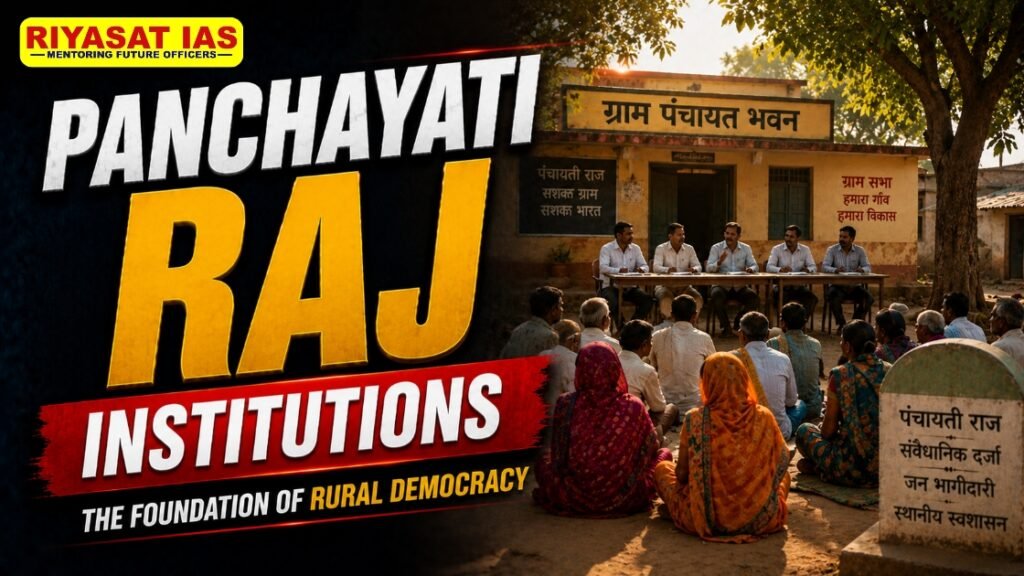
What are Panchayati Raj Institutions (PRIs)?
Panchayati Raj Institutions (PRIs) are the constitutional institutions of rural local self-government that enable democratic decentralisation and people’s participation in governance at the village level. They were given constitutional status through the 73rd Constitutional Amendment Act, 1992, which came into force on 24 April 1993.
Key Points
- PRIs constitute the third tier of government in India.
- Part IX (Articles 243–243O) deals with Panchayats.
- 11th Schedule (73rd Amendment) contains 29 subjects that may be devolved to Panchayats.
- Article 40 (DPSP) directs the State to organise village panchayats and endow them with powers.
- Panchayats promote democratic decentralisation, participatory governance, inclusive development and local accountability.
Evolution of Panchayati Raj System in India
(A) Vedic Period
The roots of local self-government can be traced to the Rig Vedic period, where village communities enjoyed considerable autonomy in managing local affairs.
- Sabha – Council of elders responsible for administration and justice.
- Samiti – General assembly involved in policy-making and public affairs.
- Vidatha – Early institution dealing with administrative, military and social functions.
- Gramani – Head of the village responsible for maintaining order and coordinating village activities.
(B) Epic Era (Ramayana & Mahabharata)
During the Epic period, village administration became more organised while retaining local autonomy. The Ramayana and Mahabharata provide references to structured rural governance and decentralised administration.
Ramayana
- The administration was broadly divided into Pur (urban/city administration) and Janapada (rural/village administration).
- Villages were governed by a Gramani (Village Head), who was responsible for maintaining law and order, collecting revenue, and supervising local administration.
- Village communities enjoyed considerable autonomy in managing local affairs.
Mahabharata
The Mahabharata describes a hierarchical system of village administration based on groups of villages:
- Gramini – Head of a single village.
- Dashagramini – Head of 10 villages.
- Vimshatipati – Head of 20 villages.
- Shatagramini (Shatapati) – Head of 100 villages.
- Adhipati (or Sahasrapati) – Head of 1,000 villages.
This hierarchy facilitated efficient administration, revenue collection, maintenance of law and order, and communication between villages and the higher authorities.
(C) Ancient Period (Mauryan & Gupta Period)
Ancient India witnessed a structured village administration with considerable decentralisation.
Kautilya’s Arthashastra
- Recognised the village as the basic administrative unit.
- Gramika acted as the village head.
- Gopa supervised a group of villages.
- Local officials maintained land records, taxation and public order.
Gupta Period
- Village assemblies enjoyed greater autonomy.
- Local bodies managed irrigation, agriculture, public works and justice.
(D) Medieval Period
Although centralisation increased under the Delhi Sultanate and the Mughals, village institutions continued to function.
- Muqaddam – Village head responsible for administration.
- Patwari – Maintained land records and collected revenue.
- Chaudhary – Assisted in revenue administration.
- Panchayats continued to resolve local disputes and regulate community affairs.
(E) British Period
· Lord Mayo’s Resolution (1870): Lord Mayo introduced financial decentralisation by transferring certain administrative and financial responsibilities to local bodies.
· Lord Ripon’s Resolution (1882): Lord Ripon advocated representative local self-government by promoting elected local bodies with greater administrative autonomy, earning him the title “Father of Local Self-Government in India.”
o Known as the “Magna Carta of Local Self-Government.”
· Elected non-official members.
o All existing local boards were required to have a two-thirds majority of elected non-official members, with the chairperson chosen from among them.
· Local participation in administration.
Decentralisation of powers.
Reduction in official interference.
Royal Commission on Decentralisation (1907): The Commission recommended reviving and strengthening village panchayats by transferring more local administrative functions to them.
Government of India Act, 1919: The Act made local self-government a transferred subject under the dyarchy system, giving Provincial Governments greater responsibility over local bodies.
Government of India Act, 1935: The Act placed local government entirely under Provincial jurisdiction, enabling Provinces to enact laws for strengthening Panchayati institutions.
Panchayati Raj after Independence: After the Constitution came into force, Article 40 promoted the organisation of village panchayats, while Article 246 empowered state legislatures to enact laws concerning local self-government.
As the Directive Principles are non-binding, local bodies did not develop a uniform structure across the country.
- After Independence, India launched the Community Development Programme (CDP) on 2 October 1952 as a rural development initiative.
- The programme covered nearly all aspects of rural development and sought to implement them through village panchayats with active public participation.
- In 1953, the National Extension Service was introduced to extend the objectives and activities of the CDP across the country; however, both initiatives achieved limited success.
- The CDP failed mainly because of bureaucratic dominance, political interference, inadequate public participation, shortage of trained personnel, and the limited involvement of local bodies, particularly village panchayats.
- India’s first Panchayati Raj system was inaugurated by Prime Minister Jawaharlal Nehru at Nagaur, Rajasthan, on 2 October 1959.



Major Committees on Panchayati Raj
Balwant Rai Mehta Committee (1957): Recommended democratic decentralisation after the Community Development Programme failed.
Major Recommendations
- Three-tier Panchayati Raj System.
- Direct election at village level.
- Zila Parishad as the advisory and coordinating body.
- Transfer of planning and development functions.
- Implemented in Rajasthan (1959), followed by Andhra Pradesh.
Santhanam Committee (1963)
Major Recommendations
- Strengthen Panchayat finances.
- Power to levy local taxes.
- Independent auditing of Panchayat accounts.
Ashok Mehta Committee (1978)
Major Recommendations
- Two-tier structure (District and Mandal Panchayat).
- District should be the basic planning unit.
- Constitutional recognition for Panchayats.
- Political party participation in Panchayat elections.
G.V.K. Rao Committee (1985)
Major Recommendations
- Strengthen Panchayats as institutions of rural development.
- Zila Parishad should become the principal planning body.
- Reduce bureaucratic dominance.
L.M. Singhvi Committee (1986)
Major Recommendations
- Constitutional status for Panchayats.
- Gram Sabha should become the foundation of democracy.
- Nyaya Panchayats for local justice.
P.K. Thungan Committee (1988)
Major Recommendations
- Constitutional status.
- Regular elections.
- Fixed tenure.
- Independent State Election Commission.
73rd Constitutional Amendment Act, 1992
The 73rd Constitutional Amendment Act, 1992 marked a historic milestone in India’s democratic decentralisation by granting constitutional status to Panchayati Raj Institutions (PRIs). The Act came into force on 24 April 1993 and established a uniform constitutional framework for rural local self-government across the country.
Major Provisions
- The Amendment inserted Part IX (Articles 243–243O) into the Constitution, which lays down the constitutional framework for the establishment, composition, powers and functioning of Panchayats.
- It also inserted the Eleventh Schedule, which contains 29 subjects that may be devolved to Panchayats for preparing and implementing plans for economic development and social justice.
- The Act provides for a three-tier Panchayati Raj system consisting of the Gram Panchayat at the village level, Panchayat Samiti at the intermediate (block) level, and Zila Parishad at the district level. However, States having a population below 20 lakhs may not constitute the intermediate level.
- It recognises the Gram Sabha (Article 243A) as the foundation of rural local democracy and empowers it to participate in planning, decision-making and monitoring of Panchayat activities.
- All members of Panchayats are elected directly by the people, while the method of electing the Chairpersons is determined by the State Legislature.
- Every Panchayat enjoys a fixed tenure of five years (Article 243E). If dissolved before the expiry of its term, fresh elections must be conducted within six months.
- The Amendment provides for the reservation of seats for Scheduled Castes and Scheduled Tribes in proportion to their population in the Panchayat area to ensure adequate political representation.
- It also mandates that not less than one-third of the total seats and Chairperson posts shall be reserved for women, including those reserved for SCs and STs. Many States have subsequently increased this reservation to 50%.
- Article 243K provides for an independent State Election Commission (SEC) in every State to supervise, direct and control the preparation of electoral rolls and the conduct of Panchayat elections.
- Article 243I mandates the constitution of a State Finance Commission (SFC) every five years to recommend the distribution of financial resources between the State Government and Panchayats.
- Article 243H empowers the State Legislature to authorise Panchayats to levy, collect and appropriate taxes, duties, tolls and fees, thereby strengthening their financial autonomy.
- Article 243G empowers the State Legislature to devolve powers, authority and responsibilities to Panchayats so that they can function as institutions of self-government and prepare plans for economic development and social justice.
Exempted areas:
- Part IX does not apply to the states of Nagaland, Meghalaya and Mizoram, which have traditional systems of tribal self-governance.
- It does not apply to the Scheduled Areas and Tribal Areas referred to under Article 244 of the Constitution.
- It does not apply to the hill areas of Manipur where District Councils function under the existing law.
- The provisions concerning district-level panchayats do not apply to the hill areas of Darjeeling in West Bengal where a separate hill council exists.
- However, Parliament extended Panchayati Raj provisions to the Fifth Schedule Areas, with suitable modifications, through the Panchayats (Extension to the Scheduled Areas) Act, 1996 (PESA).
Major Reforms in Panchayati Raj Institutions Since Their Inception
Since the enactment of the 73rd Constitutional Amendment, several legislative, financial, administrative and technological reforms have been introduced to strengthen Panchayati Raj Institutions and improve grassroots governance.
- The 73rd Constitutional Amendment Act, 1992 granted constitutional status to Panchayati Raj Institutions, ensuring regular elections, fixed tenure and democratic decentralisation.
- Several States have increased reservation for women from one-third to 50%, resulting in greater political participation and leadership of women in rural governance.
- The e-GramSwaraj Portal has been introduced to enable online planning, budgeting, accounting, monitoring and auditing of Panchayats, thereby improving transparency and accountability.
- The e-Panchayat Mission Mode Project has digitised Panchayat administration by providing online services related to governance, financial management and public service delivery.
- The Gram Panchayat Development Plan (GPDP) has strengthened participatory planning by encouraging Gram Sabhas to identify local development priorities and prepare annual development plans.
- The SVAMITVA Scheme, launched in 2020, uses drone-based GIS mapping to provide legal property ownership records in rural areas, reducing land disputes and improving access to institutional credit.
- The Rashtriya Gram Swaraj Abhiyan (RGSA) focuses on building the institutional and administrative capacity of elected Panchayat representatives through training, digital literacy and good governance practices.
- Successive Finance Commissions, particularly the 14th, 15th and 16th Finance Commissions, have significantly increased grants to local bodies for strengthening rural infrastructure and improving service delivery.
- The expansion of social audits, particularly under schemes like MGNREGA, has enhanced transparency, public participation and accountability in Panchayat functioning.
- The Government has promoted digital governance, geo-tagging of assets, online auditing and real-time monitoring to improve the efficiency and transparency of Panchayati Raj Institutions.
Challenges Faced by Panchayati Raj Institutions (PRIs)
Functional Challenges
- Many States have not fully devolved the 3Fs—Functions, Funds and Functionaries to Panchayats, leaving them dependent on State departments for implementing development programmes.
- Although the Eleventh Schedule contains 29 subjects, in many States these subjects continue to be controlled by line departments instead of Panchayats.
- Panchayats often have limited authority in planning and implementing local development projects, reducing their role to merely implementing centrally sponsored schemes.
Financial Challenges
- Most Panchayats have very limited own-source revenue because they possess weak taxation powers and poor tax collection mechanisms.
- Panchayats remain heavily dependent on grants from the Union and State Governments, reducing their financial autonomy.
- There are frequent delays in the release of Finance Commission grants and State funds, which affects the timely execution of development projects.
- Many Panchayats also face low financial management capacity, resulting in poor utilisation of available funds and delays in submission of utilisation certificates.
Administrative Challenges
- A large number of Panchayats suffer from shortage of trained technical and administrative staff, such as engineers, accountants and planning professionals.
- Elected representatives often receive inadequate training, which affects planning, budgeting and implementation of development programmes.
- Excessive bureaucratic control in many States limits the decision-making powers of elected Panchayat representatives.
Infrastructure and Technological Challenges
- Many Gram Panchayats still lack adequate office buildings, internet connectivity, computers and digital infrastructure, affecting the implementation of e-Governance initiatives.
- Weak digital literacy among Panchayat functionaries slows down the effective use of platforms such as e-GramSwaraj and e-Panchayat.
Political and Governance Challenges
- Proxy representation (Sarpanch Pati phenomenon) continues to undermine women’s political empowerment, as in many areas elected women representatives are informally controlled by male family members.
- Local elite capture, political interference and factionalism often influence decision-making and reduce transparency in Panchayat functioning.
- Gram Sabha meetings are frequently characterised by low public participation, weakening social accountability and participatory governance.
Social Challenges
- Social inequalities based on caste, gender and economic status continue to influence local governance and limit inclusive participation.
- Marginalised communities often have limited awareness of their rights and entitlements, reducing the effectiveness of democratic decentralisation.
- Women representatives frequently face social barriers, lack of capacity-building opportunities and patriarchal attitudes, restricting their independent leadership.
Lack of Convergence among Government Schemes
- Panchayats often face difficulties in converging funds and activities of multiple schemes, such as MGNREGA, PMAY-G, Jal Jeevan Mission, SBM-G and MPLADS, leading to duplication of efforts and inefficient utilisation of public resources.
- Weak coordination between Panchayats and various government departments affects integrated village planning and delays project implementation.
Way Forward
· Second Administrative Reforms Commission (6th Report – Local Governance)
The Second ARC recommended the full devolution of the 3Fs (Functions, Funds and Functionaries) so that Panchayats can function as genuine institutions of self-government rather than implementing agencies.
It also recommended strengthening Gram Sabhas and institutionalising social audits to improve transparency, accountability and citizen participation.
The Commission emphasised professional capacity-building of elected representatives and Panchayat officials through continuous training and technical support.
- The 14th, 15th and 16th Finance Commissions have recommended increasing untied grants to Panchayats and improving transparency, performance-based funding and financial accountability.
- The government should adopt the e-GramSwaraj Portal universally to improve digital planning, accounting, auditing, and monitoring of Panchayat activities.
- The government should strengthen the Gram Panchayat Development Plan (GPDP) by ensuring greater Gram Sabha participation and converging all rural development schemes.
- The Rashtriya Gram Swaraj Abhiyan (RGSA) should be expanded to provide regular training, digital literacy and administrative capacity-building for elected representatives.
- State governments may establish district-level audit committees to oversee the accuracy and integrity of financial information.
FAQs
Q1. Which Constitutional Amendment granted constitutional status to Panchayati Raj Institutions?
Ans. The 73rd Constitutional Amendment Act, 1992, which came into force on 24 April 1993, granted constitutional status to Panchayati Raj Institutions.
Q2. Which Part and Schedule of the Constitution deal with Panchayati Raj Institutions?
Ans. Part IX (Articles 243–243O) and the Eleventh Schedule (29 subjects) deal with Panchayati Raj Institutions.
Q3. Which committee laid the foundation of the modern Panchayati Raj System in India?
The Balwant Rai Mehta Committee (1957) laid the foundation of the modern Panchayati Raj System by recommending a three-tier structure based on democratic decentralisation.
Q4. Who is known as the “Father of Local Self-Government in India” and why?
Ans. Lord Ripon is known as the “Father of Local Self-Government in India” because of his Resolution on Local Self-Government (1882), which promoted elected local bodies and administrative decentralisation.
Q5. What are the three tiers of the Panchayati Raj System?
Ans. The three tiers are Gram Panchayat (Village Level), Panchayat Samiti (Intermediate/Block Level), and Zila Parishad (District Level).


 Ravi Raaz
 Hassan Khan
 Shadab Ali