
Introduction
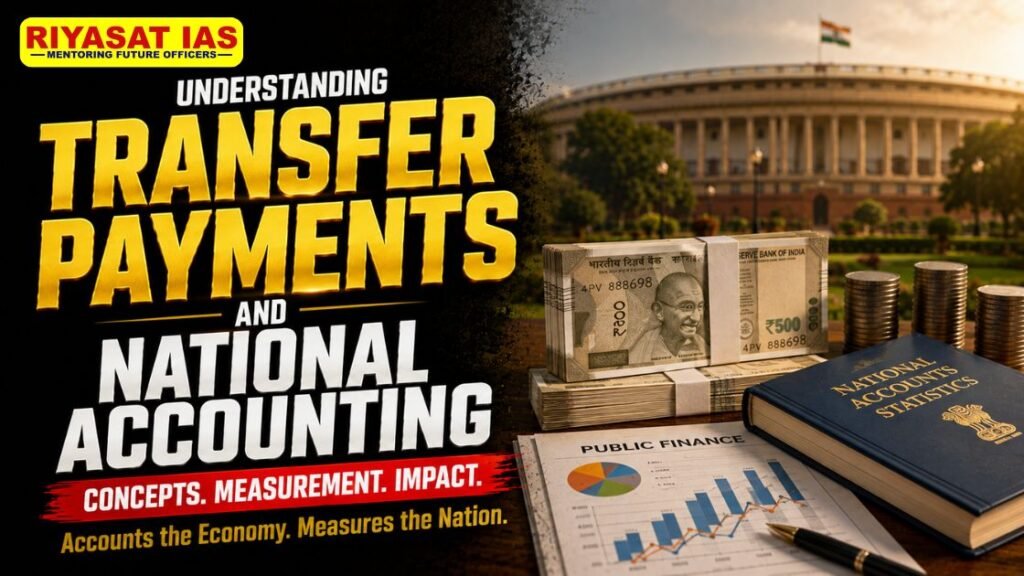
Transfer Payments are an important component of public finance and social welfare policies. They refer to payments made by the government or other institutions without receiving any goods or services in return. These payments are intended to provide financial assistance, reduce income inequality, and strengthen social security rather than generate current economic output.
Although Transfer Payments increase the disposable income of households and improve living standards, they do not contribute directly to Gross Domestic Product (GDP) or National Income because they are not made in exchange for the production of goods or services. Consequently, they are excluded from the estimation of GDP under the Production, Income, and Expenditure methods of national income accounting.
In India, Transfer Payments play a crucial role in supporting vulnerable sections of society through pensions, scholarships, food subsidies, Direct Benefit Transfers (DBT), and income support schemes such as PM-KISAN. While these transfers strengthen consumption and social welfare, they represent a redistribution of existing income rather than the creation of new economic value.
For UPSC aspirants, understanding the treatment of Transfer Payments in National Income Accounting is important because it links the concepts of GDP, National Income, Public Finance, Welfare Economics, Fiscal Policy, and Social Protection.
Why are Transfer Payments Important?
Transfer Payments are an important instrument of fiscal policy because they protect vulnerable households, reduce poverty, and strengthen aggregate demand without directly increasing current production.
The topic is closely associated with:
- National Income Accounting
- Gross Domestic Product (GDP)
- Gross Value Added (GVA)
- Fiscal Policy
- Public Finance
- Direct Benefit Transfer (DBT)
- Social Welfare
- Disposable Income
- Poverty Alleviation
- Inclusive Growth
What are Transfer Payments?
Transfer Payments are unilateral payments made by the government or institutions to individuals or organisations without receiving any goods, services, or productive factors in return.
Unlike wages, rent, interest, or profits, transfer payments are not factor payments because they do not arise from current production. Instead, they redistribute income from one section of society to another.
Common Examples of Transfer Payments
- Old-age pensions
- Scholarships
- Unemployment benefits
- PM-KISAN income support
- MGNREGA unemployment allowance
- Social security pensions
- Food subsidies
- Cash transfers through Direct Benefit Transfer (DBT)
Although these payments improve household income, they do not create additional goods or services in the economy.
Treatment of Transfer Payments in National Income Accounting
Transfer Payments are treated differently from factor payments because they do not represent payment for current production. Therefore, they are excluded from the calculation of GDP and National Income.
Excluded from Gross Domestic Product (GDP)
- GDP measures the market value of all final goods and services produced within an economy during a given period.
- Since Transfer Payments do not involve the production or purchase of goods and services, they are excluded from GDP estimation.
Excluded from Gross Value Added (GVA)
- Gross Value Added (GVA) measures the value added by producers during the production process.
- As Transfer Payments do not contribute to production, they are not included in GVA.
Excluded under the Income Method
Under the Income Method, GDP is estimated by adding factor incomes such as:
- Wages and Salaries
- Rent
- Interest
- Profits
- Mixed Income
Since Transfer Payments are not payments to factors of production, they are excluded from National Income estimation.
Redistribution of Existing Income
- Transfer Payments do not increase the economy’s productive capacity.
- Instead, they redistribute existing income from taxpayers or the government to beneficiaries, improving income distribution without creating additional output.
Included in Disposable Income
- Although Transfer Payments are excluded from GDP and National Income, they increase the disposable income of households.
- Higher disposable income enables households to spend more on consumption or increase savings, thereby indirectly influencing economic activity.



International Standard
- According to the United Nations System of National Accounts (SNA 2008), Transfer Payments are classified as redistribution transactions rather than production activities.
- Therefore, they remain outside the scope of GDP and National Income estimation.
Macroeconomic Significance of Transfer Payments
Although Transfer Payments are excluded from National Income Accounting, they play an important role in promoting economic stability and social welfare.
Strengthen Social Protection
- Transfer Payments provide financial support to economically vulnerable groups such as senior citizens, farmers, students, women, persons with disabilities, and low-income households.
- This improves social security and reduces poverty.
Increase Disposable Income
Cash transfers increase household purchasing power by raising disposable income.
Higher income enables families to spend more on food, healthcare, education, and other essential goods and services.
Boost Aggregate Demand
- Low-income households generally have a higher Marginal Propensity to Consume (MPC).
- As a result, transfer payments often lead to higher consumer spending, which supports aggregate demand and economic activity.
Act as Automatic Stabilisers
- During economic slowdowns, pandemics, or natural disasters, Transfer Payments help protect household income and sustain consumption.
- This reduces the severity of economic downturns and supports recovery.
Promote Human Capital Development
Government expenditure on education, healthcare, nutrition, scholarships, and pensions improves human capital by enhancing health, skills, and labour productivity.
Improve Welfare Delivery
Digital platforms such as Direct Benefit Transfer (DBT) have made welfare delivery more transparent and efficient by transferring benefits directly to beneficiaries, reducing leakages and improving service delivery.
Implications of Transfer Payments for National Income Accounting
Although Transfer Payments are excluded from the calculation of GDP and National Income, they have significant implications for the overall economy. By increasing household income and supporting consumption, they indirectly influence economic growth even though they do not represent current production.
No Direct Contribution to GDP
- Transfer Payments are not included in Gross Domestic Product (GDP), Gross Value Added (GVA), or National Income because they are not made in exchange for the production of goods or services.
- As they do not involve any value addition, they are treated as redistribution of income rather than production activities.
Increase Household Disposable Income
- Transfer Payments increase the disposable income available to households without requiring them to produce goods or services.
- Higher disposable income enables households to spend more on consumption or increase savings, thereby improving their standard of living.
Support Consumption-led Growth
- An increase in household purchasing power often results in higher consumption expenditure, particularly among low-income households that have a higher propensity to consume.
- Although the transfer itself is excluded from GDP, the additional expenditure on goods and services contributes to economic output and supports growth.
Generate Multiplier Effects
Higher consumer spending creates additional demand for goods and services, encouraging businesses to expand production, generate employment, and invest further.
This creates a multiplier effect that indirectly contributes to economic growth.
Fiscal Implications
- Transfer Payments form an important component of government Revenue Expenditure. A continuous increase in welfare expenditure without corresponding growth in revenue may widen the fiscal deficit and reduce the fiscal space available for productive capital investment.
- Therefore, governments must balance social welfare objectives with fiscal sustainability.
Challenges Associated with Transfer Payments
Transfer Payments play an important role in promoting social welfare, but their effective implementation presents several fiscal and administrative challenges.
Fiscal Burden
- Growing expenditure on pensions, subsidies, income support schemes, and social welfare programmes increases pressure on government finances.
- If welfare commitments rise faster than government revenue, fiscal deficits and public debt may increase.
Targeting Errors
- The effectiveness of welfare programmes depends on accurate identification of beneficiaries.
- Inclusion errors allow ineligible individuals to receive benefits, while exclusion errors prevent deserving beneficiaries from accessing government support.
Leakages and Fraud
- Although Digital Public Infrastructure (DPI) has significantly reduced leakages, continuous beneficiary verification remains necessary to eliminate duplicate and fraudulent claims.
- Strengthening digital governance can further improve transparency and accountability.
Measurement Gap
- Transfer Payments improve household welfare and reduce poverty, but they remain excluded from GDP because they do not represent current production.
- As a result, conventional measures of National Income may not fully capture improvements in social well-being.
Rising Demographic Pressures
- Population ageing, urbanisation, and expanding social security programmes are likely to increase future expenditure on pensions, healthcare, and income support.
- Managing these commitments while maintaining fiscal sustainability will remain a major policy challenge.
Way Forward
Way Forward
• Strengthen Direct Benefit Transfer (DBT): Expand Aadhaar-enabled Direct Benefit Transfer and adopt advanced digital verification systems to improve transparency, reduce leakages, and ensure timely delivery of benefits.
• Improve Targeting of Beneficiaries: Develop integrated digital beneficiary databases to minimise inclusion and exclusion errors, ensuring that welfare benefits reach deserving households.
• Promote Sustainable Livelihoods: Complement transfer payments with investments in education, healthcare, skill development, entrepreneurship, and employment generation to help beneficiaries become economically self-reliant.
• Ensure Fiscal Sustainability: Balance welfare expenditure with productive capital investment to maintain fiscal discipline while continuing to support vulnerable sections of society.
• Leverage Digital Public Infrastructure (DPI): Integrate platforms such as Aadhaar, Jan Dhan, GSTN, e-Shram, and social registries to improve beneficiary identification, monitoring, and efficient welfare delivery.
• Adopt Outcome-based Evaluation: Evaluate welfare schemes based on measurable improvements in poverty reduction, nutrition, education, employment, financial inclusion, and human development rather than merely on the amount of expenditure.
Conclusion
Transfer Payments are an important instrument of social protection and inclusive development. Although they do not contribute directly to Gross Domestic Product (GDP) or National Income, they improve household welfare, strengthen disposable income, reduce poverty, and support aggregate demand.
An efficient transfer payment system, supported by digital governance, accurate beneficiary targeting, and prudent fiscal management, can enhance the effectiveness of welfare programmes while maintaining the integrity of National Income Accounting. As India expands its social protection framework, balancing welfare objectives with fiscal sustainability will remain essential for achieving inclusive and sustainable economic development.
Frequently Asked Questions (FAQs)
1. What are Transfer Payments?
Transfer Payments are unilateral payments made by the government or institutions without receiving any goods or services in return. Examples include pensions, scholarships, subsidies, and Direct Benefit Transfers (DBT).
2. Why are Transfer Payments excluded from GDP?
Transfer Payments do not involve the production of goods or services or payment to factors of production. Therefore, they are excluded from GDP and National Income estimation.
3. Do Transfer Payments affect National Income?
No. Transfer Payments do not directly increase National Income because they represent a redistribution of existing income rather than new production.
4. How do Transfer Payments influence the economy?
They increase household disposable income, strengthen consumption, reduce poverty, support aggregate demand, and improve social welfare.
5. Are Transfer Payments included in Disposable Income?
Yes. Although excluded from GDP, Transfer Payments increase household disposable income and influence consumption and savings.
6. What is the relationship between Transfer Payments and Direct Benefit Transfer (DBT)?
Direct Benefit Transfer (DBT) is a digital mechanism used by the Government to transfer welfare benefits directly into beneficiaries’ bank accounts, making Transfer Payments more transparent and efficient.
7. What are the major challenges associated with Transfer Payments?
Major challenges include fiscal burden, targeting errors, leakages, demographic pressures, and balancing welfare expenditure with fiscal sustainability.
8. Why are Transfer Payments important?
Transfer Payments strengthen social protection, reduce poverty and inequality, support human capital development, and act as automatic stabilisers during economic slowdowns.




 Ravi Raaz
 Hassan Khan
 Shadab Ali