
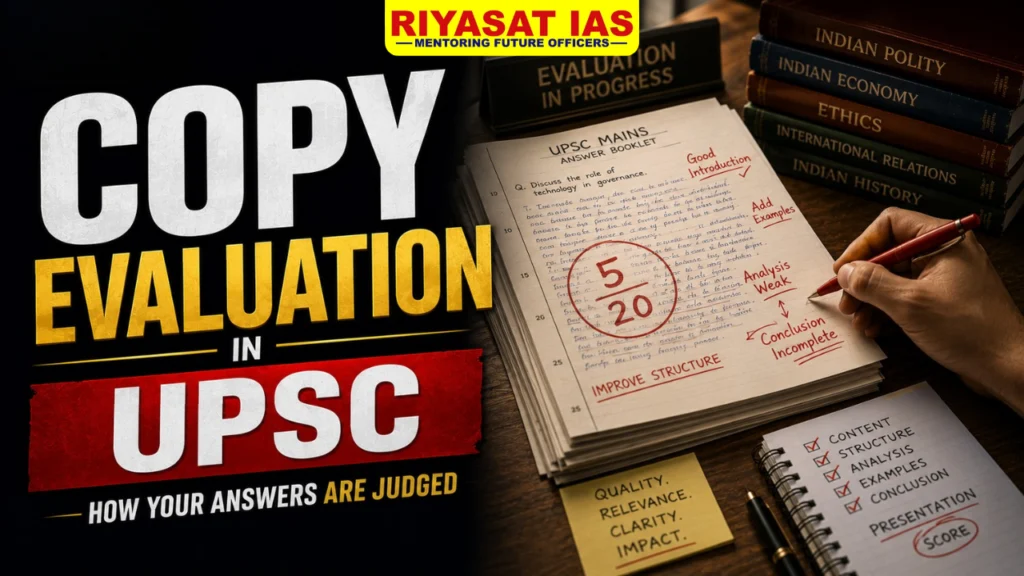
Understand how UPSC evaluators assess Mains answer booklets because the way they read your answers should shape the way you write them. Most aspirants write for an ideally attentive reader with unlimited time. UPSC Mains evaluators are under significant time pressure, reading hundreds of booklets. The difference between these two reading contexts shapes everything from how you structure your answers to how you underline key terms.
The Evaluation Process: What Happens After the Examination
After UPSC Mains, answer booklets are collected, numbered, and dispatched to evaluators assigned by UPSC from the relevant academic and professional community. Each paper has a Head Examiner and a team of Assistant Examiners. The evaluation process:
- Before evaluation begins, UPSC prepares a model answer scheme and discusses it with Chief Examiners. This process establishes the key value points that evaluators expect to see in high-scoring answers.
- Each evaluator assesses a batch of booklets independently, assigning marks to individual answers within each booklet
- A portion of booklets are cross-checked by senior examiners to ensure marking consistency across the evaluation team
- Evaluators are expected to mark an average of 20–30 booklets per day — which translates to approximately 2–5 minutes per booklet and 1–2 minutes per answer for initial assessment
- A second moderation occurs where significant outlier marks are reviewed and potentially revised
What Evaluators Are Specifically Looking For
UPSC uses a marking scheme that identifies the specific value points in each answer. These include relevant content, analytical reasoning, and supporting evidence that earn marks. Although UPSC does not publish the marking scheme, consistent patterns in toppers’ answer copies and examiner feedback clearly show what evaluators reward.
| What Earns Marks | What Does Not Earn Marks |
| Specific constitutional article numbers cited with their provisions | Vague references to ‘the Constitution’ without article specificity |
| Named schemes with at least one specific metric or implementation detail | Generic references to ‘government schemes’ or ‘welfare programmes’ |
| Landmark judgment citations with the year and the principle established | Vague references to ‘Supreme Court judgments’ without case names |
| Multi-dimensional analysis — covering economic, social, governance, constitutional, or environmental dimensions as appropriate to the question | Single-dimension treatment — covering only one angle of a multi-dimensional topic |
| An explicit conclusion that resolves the question or provides a principled judgment | A conclusion that restates the introduction or ends with ‘therefore, this is important’ |
| Evidence of current affairs integration — a specific recent development connected to the answer’s analytical point | Awareness without integration — mentioning a current event without connecting it to the answer’s argument |
| Want your answers evaluated specifically against these examiner criteria? → Explore Answer Writing Mentorship at Riyasat IAS |



The Time Pressure Reality: What It Means for Presentation
Evaluators reading 20–25 booklets per day across multiple papers develop a scanning efficiency that shapes how answers are read. The initial read of each answer is approximately 60–90 seconds — a scanning pass that identifies the answer’s structural quality (does it have a clear three-part structure?), visible evidence items (can the evaluator spot article numbers, scheme names, judgment citations?), and conclusion quality (does the final paragraph add something or restate the opening?).
This scanning-first reading has direct implications for presentation:
- Underlining key terms makes them visible in the scan: Article numbers, judgment names, scheme names, and committee recommendations underlined in your answer are immediately visible in the evaluator’s scanning pass. The same information buried in uninterrupted prose may be missed or take longer to locate.
- Clear paragraph breaks signal structure: An answer with visually distinct paragraphs (introduction clearly separate from body; conclusion clearly separate from body) communicates structural awareness in the first second of the evaluator’s attention. Dense, unbroken prose requires the evaluator to work harder to extract the answer’s structure.
- The first and last sentences carry disproportionate weight: In a scanning read, the first sentence of the answer (which signals whether the question was understood and the introduction is question-specific) and the last sentence (which signals whether the conclusion synthesises or restates) are read with particular attention. Invest more planning time in these two sentences than in any others.
- Legibility is a non-negotiable baseline: An evaluator who cannot read content cannot credit it. Handwriting does not need to be beautiful; it needs to be legible at the speed you write under examination conditions. Practise writing at examination speed from Month 3 — not carefully at leisure, but legibly at pace.
How Many Value Points Does a Typical GS Answer Need?
Based on publicly available UPSC marking patterns and evaluation norms, the approximate value point distribution for GS Mains answers:
| Marks Allocation | Expected Value Points | Approximate Time Window | What This Means in Practice |
| 10 marks | 4–5 value points | 8–9 minutes to write; ~90 seconds for evaluator to assess | Each body paragraph must make one clear analytical point with one named evidence item — no room for padding or repetition |
| 15 marks | 6–8 value points | 12–13 minutes to write; ~2 minutes for evaluator | Three to four distinct analytical dimensions with evidence items; a conclusion that synthesises rather than restates |
| 20 marks | 8–10 value points | 17–18 minutes to write; ~2.5–3 minutes for evaluator | Five to six clearly differentiated analytical dimensions; multiple named evidence types (scheme + judgment + data); a forward-looking conclusion |
A value point is not a sentence — it is a distinct analytical claim with supporting evidence. ‘RTI strengthens accountability’ is not a value point. ‘RTI’s Section 4 mandatory disclosure requirement, extended by the DPDP Act’s transparency provisions, has reduced informational asymmetry between citizens and administration in [specific domain]’ is a value point.
Why Getting Re-Evaluation Does Not Help Most Aspirants
UPSC provides a marks verification service (not a re-evaluation) where aspirants can verify whether marks were totalled correctly. The marks themselves are not re-evaluated in standard practice. This is important preparation knowledge: if your GS scores are disappointing, the reason is almost certainly not a marking error — it is that the answers did not meet the evaluator’s value point expectations. The productive response to disappointing scores is preparation diagnosis and change, not marks verification.
Frequently Asked Questions
Does UPSC evaluate subjectively, or is there a fixed marking scheme?
Both. There is a structured marking scheme with specific value points that guide evaluators — this is the ‘objective’ element. But the award of partial marks within a value point, the assessment of analytical depth and coherence, and the evaluation of whether a conclusion synthesises or restates are inherently judgmental — the ‘subjective’ element. Understanding this dual nature explains why two competent evaluators reading the same answer may give marks differing by 2–3 in each answer — the objective framework is the same, the judgment applied within it varies.
Can a well-presented but analytically weak answer score well?
Briefly — in the scanning phase, a well-presented answer creates a positive initial impression that may lead the evaluator to read more carefully for value points. But presentation cannot create value points that are absent. A beautifully structured answer with clear paragraphs, selective underlining, and a distinct conclusion that contains no named evidence items and no analytical claim will not score significantly better than a dense answer with the same content. Presentation earns its marks by making genuine content visible; it cannot substitute for content.
Should I write GS answers in bullet points or in continuous prose?
The format should match the question’s demand, as described in the answer writing guide: factual multi-dimensional questions suit numbered or bulleted points; analytical argumentative questions suit continuous paragraphs. What matters is that the chosen format makes the answer’s structure and value points clearly visible to an evaluator scanning under time pressure. Bullet points that each contain one analytical claim with one evidence item are more readable than dense prose paragraphs; continuous paragraphs that develop a coherent argument are more appropriate for analytical questions than lists of disconnected points.
Conclusion
Understanding UPSC Mains copy evaluation — the time pressure evaluators work under, the value point framework that guides marks, the scanning-first reading pattern, and the presentation elements that make content visible — transforms how you approach answer writing practice. Write for an evaluator who will scan your answer in 90 seconds before reading it carefully: structure your answer so the scan reveals its quality. Name every piece of evidence you cite. Invest in the first and last sentences. Underline key terms. These are not examination tricks — they are the preparation practices that ensure the analytical quality you have built across months of preparation is legible, findable, and credit-worthy when an evaluator reads your booklet under time pressure.
| Riyasat IAS Mentorship — Personal Guidance for UPSC CSE Direct mentorship from Riyasat Ali Sir │ Hindi & English Medium │ 100% Online — Apply Now |


 Ravi Raaz
 Hassan Khan
 Shadab Ali