
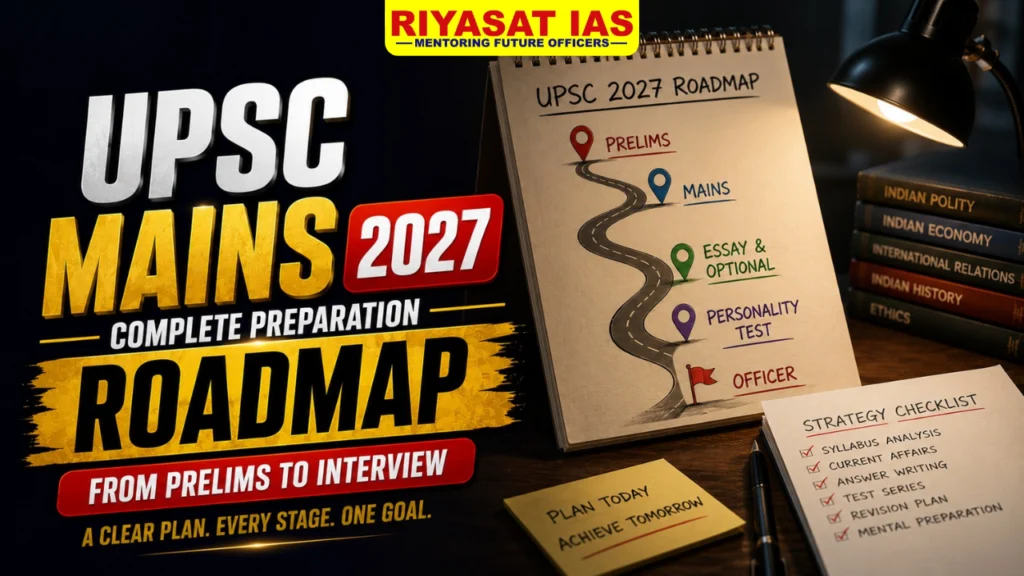
UPSC Mains 2027 will likely be scheduled for September–October 2027. With the July 2026 starting point, aspirants targeting Mains 2027 have approximately 14–15 months of preparation available — enough time to build a genuinely competitive Mains preparation across all components if the preparation architecture is correct and the time is used efficiently.
This roadmap gives you a specific, month-by-month plan from July 2026 through the 2027 Mains and, for those who clear, the subsequent Interview stage. Each phase has a primary focus, specific weekly milestones, and the quality benchmarks that tell you whether the phase is on track.
Phase 1: Foundation (July–October 2026, 4 Months)
| Month | Primary Activities | Weekly Milestones | Quality Benchmark |
| July 2026 | NCERTs: History, Geography, Polity (Classes 6–12 relevant). Current affairs system established — daily reading + same-day GS-tagged notes. Optional Subject: selection finalised; foundational reading begins | 2 NCERT chapters per day; current affairs notes: 5–7 entries per week; Optional: 1 chapter per day | Can recall key facts from covered NCERT chapters after 48 hours without notes |
| August 2026 | NCERTs: Economics, Science, remaining subjects. Primary reference begins: Laxmikanth (Polity) Chapter 1–15. First answer writing: 150-word structured responses on covered Polity topics | Laxmikanth: 3–4 chapters per week with PYQ practice; 1 answer daily from Week 3; Optional: 2 chapters per day | PYQ accuracy on covered Polity chapters: 60%+; answer structure includes distinct intro, body, conclusion |
| September 2026 | Primary references continue: Modern History + Economy basics. Answer writing expands to 250 words (full Mains length). First timed essay written and evaluated | Primary reference coverage: 4 chapters per week; 2 answers daily; 1 essay per month | PYQ accuracy on covered topics: 65%+; essays engage the topic rather than the generic theme |
| October 2026 | GS Paper II and III primary reference deepening. Optional Subject: first paper nearing completion of coverage. Revision architecture confirmed: 3-week cycle running | Paper II and III: 4 chapters per week; Optional: 2 answers per week submitted for review; Revision Cycle 3 running | Can write a 250-word analytical answer on Polity and Economy topics in 12 minutes; Optional answers structurally coherent |
P2: Development (November 2026–February 2027, 4 Months)
| Month | Primary Activities | Weekly Milestones | Quality Benchmark |
| November 2026 | GS Paper I deepening: Society, post-independence India. Environment and Ecology primary reference. Ethics: framework reading begins + first case study practice | Environment: 3 chapters per week; Ethics: 2 thinker application cards built per week; 1 case study per week | Environment PYQ accuracy: 60%+; Ethics case studies include all five steps (even imperfectly) |
| December 2026 | First full Prelims mock test (baseline). GS revision architecture: Cycle 4 running on earliest covered material. Optional Paper 2 begins; Essay: 2 essays this month with evaluation | Mock test taken; error categorisation complete within 48 hours; Optional Paper 2: Week 1 coverage; Essay: 2 evaluated essays | Mock test error categorisation by type (knowledge/recall/reasoning/careless); Cycle 4 revision material retaining 70%+ of Cycle 1 |
| January 2027 | Mock-test-driven revision: 3 weeks of targeted revision from December mock errors. Answer writing deepens: 3 GS answers daily. Ethics: weekly case study with five-step structure; Section A concepts | Targeted revision of 3 weakest mock test subjects; 3 GS answers daily (rotate across papers); Ethics: 1 evaluated case study per week | GS answers cite at least 2 named evidence items; case studies complete all five steps in 12 minutes |
| February 2027 | Second full Prelims mock test. Optional Paper 2 coverage nearing completion. Current affairs capsule revision: 6 months reviewed | Second mock taken; error pattern comparison with December mock; Optional Paper 2: review first paper answers and Optional coverage completeness | Mock test trajectory improved from December; Optional Paper 2 answers coherent if not yet polished; 6-month current affairs organised |
| Want weekly mentorship across this full roadmap from Riyasat Ali Sir? → Apply for Mains Mentorship at Riyasat IAS |



Phase 3: Consolidation (March–May 2027, 3 Months — Through Prelims)
This phase runs through the Prelims preparation intensification and the examination itself. The critical discipline: Mains preparation (answer writing, Optional, Ethics) must not be abandoned for Prelims consolidation. Continue the daily answer writing and weekly Optional review even during the Prelims sprint.
- March 2027: Third mock test; full Prelims consolidation mode (mock tests twice weekly); answer writing continues (1 daily minimum even in Prelims sprint)
- April 2027: Prelims consolidation — mock tests, current affairs rapid revision, weak-subject targeted drilling; answer writing reduced to 3–4 per week but not stopped
- May 2027: Prelims examination; immediately after — Mains preparation resumes at full intensity, not waiting for results
Phase 4: Mains Intensive (June–September 2027, 3–4 Months)
| Month | Primary Focus | Daily Schedule (8 Hours) | Key Milestone |
| June 2027 | Transition audit: assess what Prelims phase produced; identify gaps; restructure daily schedule for Mains intensity | Morning (3h): 4 GS answers; Afternoon (2h): Optional (2 answers); Evening (2h): current affairs revision + Ethics; Night (1h): revision capsule scan | Transition audit complete; revised daily schedule confirmed; 3 GS answers per day minimum running |
| July 2027 | GS intensive: answer writing at exam speed; weekly full GS paper mock; current affairs integration in every answer | Morning (3h): 4 timed GS answers; Afternoon (2h): Optional (2 answers + review); Evening (2h): current affairs + Ethics timed case study; Night (1h): capsules | Mock GS paper weekly; all answers timed strictly; Optional answers show subject-specific depth |
| August 2027 | Ethics intensification: daily timed case studies; Essay: 2 evaluated per month; Optional: complete revision + 2 daily answers | Morning (3h): GS answers; Afternoon (2h): Optional; Evening (1.5h): Ethics (2 case studies daily); Night (1h): Essay writing and revision capsules | Ethics: 10-minute case study target approaching; Essay topic interpretation consistently accurate; Optional revision complete |
| September 2027 | Final consolidation: current affairs complete revision; capsule-only revision; no new content; daily ethics case study | Morning (2h): capsule revision; Afternoon (2h): Optional answers; Evening (2h): current affairs capsule + ethics; Night: sleep | All 12 monthly current affairs capsules revised twice; GS capsules complete; examination logistics confirmed |
Phase 5: Interview Preparation (October–December 2027)
For aspirants who clear Mains, the Interview (Personality Test) carries 275 marks. Interview preparation begins after Mains results and involves three specific activities: DAF (Detailed Application Form) preparation — anticipating and preparing for questions from every element of the DAF; current affairs discussion practice — engaging current governance, international, and social issues analytically in a spoken context; and mock interviews — structured practice sessions that simulate the board’s questioning style and allow feedback on expression, composure, and analytical quality.
- November 2027: DAF analysis — prepare 5–8 potential questions for each DAF entry; draft and refine answers; current affairs compilation of the year’s major developments
- December 2027: Mock interviews (minimum 3–4 with experienced panellists); feedback-driven refinement of both DAF answers and current affairs discussion quality
Frequently Asked Questions
Is 14–15 months enough for a first-time aspirant to prepare competitively for Mains 2027?
Yes — 14–15 months with the correct preparation architecture (integrated answer writing from Month 3, Optional from Month 3–4, Essay from Month 4, Ethics from Month 5–6, and current affairs system from Day 1) is sufficient for a competitive first Mains attempt. The most common first-attempt failure pattern — beginning answer writing after Prelims — produces a 3–5 month answer writing development period, which is insufficient. Beginning in Month 3 gives the 9+ months that competitive Mains performance requires.
What if I have already started preparation but not following this roadmap — can I adjust mid-cycle?
Yes — begin with a preparation audit at whatever point you are currently at. Identify which roadmap activities are running (current affairs system, answer writing, Optional Subject) and which are not. Immediately begin the activities that are absent, even if they are starting later than the roadmap suggests. A current affairs system started in Month 5 is significantly better than one started in Month 9. An answer writing habit started in Month 6 is significantly better than one started after Prelims.
How should the roadmap adjust for a working professional with limited daily hours?
Compress the daily hours but maintain all activities. A working professional with 5 hours per day moves more slowly through coverage and primary references — the foundation phase may extend from 4 months to 6–7 months. The non-compressible activities are: daily current affairs (45 minutes minimum); answer writing (1 answer daily minimum from Month 3); Optional Subject (1 hour minimum daily). These three activities are protected even when other activities are compressed.
Conclusion
The UPSC Mains 2027 preparation roadmap from July 2026 through the examination and, for successful aspirants, the subsequent Interview is a 15-month journey with five distinct phases: Foundation (NCERTs, source framework, current affairs system, answer writing introduction), Development (primary reference completion, first mock tests, answer quality deepening), Consolidation (Prelims phase with Mains maintenance), Mains Intensive (4 GS answers daily, Optional, Ethics, current affairs integration), and Interview Preparation. Each phase has specific milestones and quality benchmarks. Following the roadmap does not guarantee selection — but departing from its core disciplines (early answer writing, Optional discipline, Essay practice, external evaluation) consistently reduces the probability of Mains performance that results in selection.
| Riyasat IAS Mentorship — Personal Guidance for UPSC CSE Direct mentorship from Riyasat Ali Sir │ Hindi & English Medium │ 100% Online — Apply Now |


 Ravi Raaz
 Hassan Khan
 Shadab Ali