
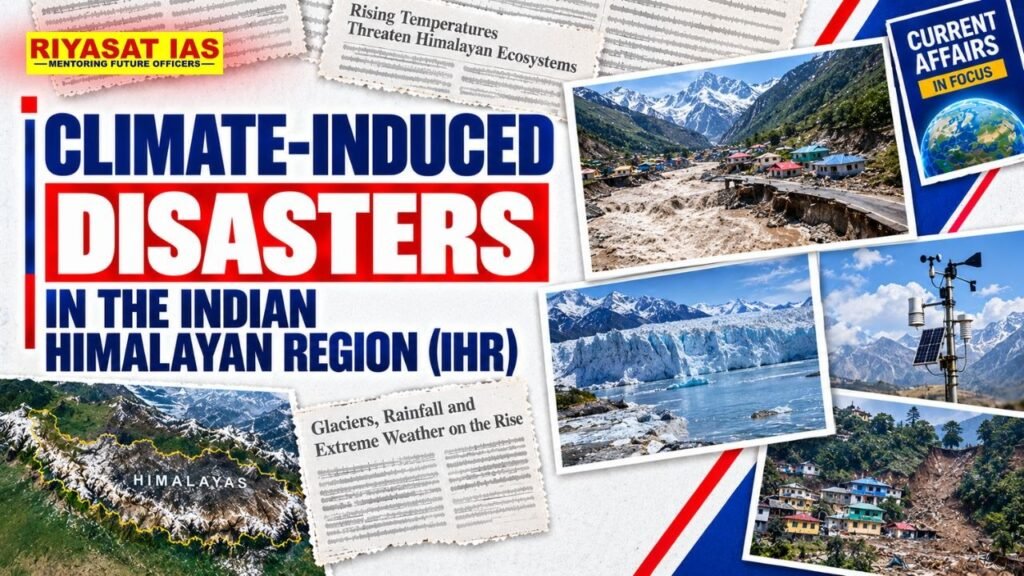
GS-III | Environment and Ecology | Climate Change | Disaster Management | Sustainable Development
Climate Crisis in the Indian Himalayan Region
- Sustainable Development: For decades, the effort toward sustainable, climate-resilient, and hazard-resistant development in the Indian Himalayan Region (IHR) has been ignored and has resulted in frequent and severe climate-induced disasters.
- Global natural commons in crisis: The catastrophic floods in Nepal on August 26th signal that the global natural commons, extending from the Hindu Kush and Karakoram to the Himalayas, are in an existential crisis.
- Rapid Mountain Warming: The rapid warming of mountain areas (such as those in Asia) has been reported by the IPCC and WMO to be occurring at a rate of 0.3 degrees Celsius each ten years, almost two times the rate of temperature increases for the rest of the world.
- Consequences of Warming: Rising temperatures are causing glacier retreat, decreasing mountain-slope stability and infrastructure integrity, threatening water security, livelihoods and ecosystems, and increasing disaster risk.
- Accelerating Ice Loss: Reports published by ICIMOD on March 21st, 2026, show that ice loss rates for the entire Hindu Kush Himalayas (HKH) have been growing at twice the rate they were in 2000.
- Uneven Heating: According to the Journal of Earth System Science, the western Himalayas are experiencing a consistent rise in temperature compared to the central and eastern portions, as well as experiencing the fastest rate of increases in nightly minimums and winter temperatures.
- Climate Justice: Nepal accounts for approximately 0.1% of global greenhouse gases, yet is requesting reparation for loss and damage caused by a crisis that was not produced by Nepal.
Rising Temperatures and Their Effect on Glaciers
- Glacier Retreat: The rise in atmospheric temperature shifts the equilibrium of winter snow accumulation versus summer melting of glaciers. This causes glaciers to recede and become progressively thinner.
- Rising Ice Temperature: Ice with an earlier temperature range of -6 degrees Celsius to -20 degrees Celsius is currently at approximately -2 degrees Celsius and will therefore be more likely to melt.
- Supraglacial lakes and moulins: Meltwater pools on top of glaciers in supraglacial lakes and carves vertical shafts called moulins that go hundreds of meters down through the ice to the rock below.
- Glacier Acceleration: The acceleration of glaciers is caused by the lubrication provided by pressure of the water that exists between the rock and the ice, which enables the glacier to move faster down the slope.
- Glacial Fracturing: The water that flows through subglacial channels (between the glacier and the bedrock), and through englacial channels (within the glacier), produces mechanical forces strong enough to create fractures in the ice.
- Permafrost Thaw: Permafrost (defined as ground/rock that is always at/below 0 degrees Celsius), serves as geological cement because it fills the cracks, joints and pores in the rocks/ground with frozen water.
- Slope Instability: As temperatures increase, the frozen ground (permafrost) will melt, creating large amounts of liquid water. This melting will lead to instabilities in the landforms and create potential hazards for people living below these slopes such as landslide events, rock avalanches and/or debris flows.



Measures to Reduce Disaster Impacts
- Regional Cooperation: There are no technologies that can stop these types of failures. The only way to lessen the effects of failures on those living below the site of a failure is to cooperate regionally and develop a common method for sharing real-time information.
- Satellite and Drone Surveillance: High-altitude satellite and drone surveillance are critical tools for identifying early indicators of cliff collapse, permafrost melting and glacier instability.
- Real-Time Monitoring Sensors: Acoustic and hydrologic sensors positioned on glacier-fed rivers can provide rapid warning of potential subsurface activity (such as collapse) or extreme flow conditions (such as flooding), allowing for timely notification to downstream populations.
- Glacial Lake Monitoring: It is essential to continuously monitor glacial lakes and, if possible, engineering to drain them.
- River Flood Zoning: Flood zoning must account for valley slope. Steeper slopes concentrate damage vertically, requiring infrastructure to be located much higher above the riverbed, while gentler slopes spread destruction horizontally and demand a different zoning approach.
Rethinking Hydropower and River-Linking Projects
- Hydropower Policies: A complete review of hydropower policies is required and we need to impose a strict ban on building above a certain level of elevation.
- Committee Recommendations: The Avay Shukla Committee (Court on Its Own Motion vs State of Himachal Pradesh and Others) and the Ravi Chopra Committee have recommended that all large scale hydropower projects should be restricted or that any development work that is carried out at elevations greater than 2,200 meters should undergo a comprehensive expert assessment.
- Chenab–Beas River-Linking Project: The proposed link is an 8.7 kilometer tunnel constructed on the steep sides of the Pir Panjal Range in Lahaul & Spiti District; the location is located near the village of Koksar in Himachal Pradesh. The elevation of this site is 3140 meters (10,300 feet).
- Environmental Concerns: The proposed diversion of additional water from the western rivers of the Indus system would seem to be a rational decision based upon economics; however, because the proposed project will be situated within a highly sensitive Himalayan ecosystem, and because it is highly probable that the resulting environmental consequences will render the project an unreasonable choice, it should not proceed.
Way Forward
- Climate Resilient Development: Every development project that is undertaken within the Indian Himalayan Region (IHR) needs to be assessed with respect to how the geological reality of the Himalayas is changing.
- Moratorium on Development Projects: There must be a moratorium placed on all development projects until each is reviewed extensively to determine the environmental effects, level of risk aversion, and ability to withstand changes due to climate.
- Regional Data Exchange: Set up a shared system for exchanging real-time data to help reduce the negative effects of mountain collapses on communities downstream.
- Early-Warning Systems: The early warning system is an improvement over current systems. It uses more advanced technology to provide real-time data about flooding risk. This includes using better high-altitude satellites and drones to monitor areas at higher risk of flooding. It also utilizes real-time acoustic sensors to detect rising water levels and hydrological sensors to track changes in water flow. When there are indications that a community may be in danger from flooding, the system immediately sends out alerts to those communities.
- Continuous Glacial Lake Monitoring : Continuous monitoring of glacial lakes should occur with engineering drainage as necessary.
- Slope-Sensitive Flood Zoning: The zoning of river floods should take into account the slope of the valley where they occur. This is because there are two distinct ways in which floods destroy areas based upon whether the valley is steep or has a gentle slope.
- Hydropower limitations: rethink your hydropower policy and put in place limits on the size of major projects and/or have an independent panel of experts conduct a full review of any proposed development that will take place at elevations higher than 2,200 meters.
- Re-evaluation of River-linking Projects: Reassess the proposal to link rivers like the Chenab and Beas, with consideration given to the potential impact of these projects on the sensitive environments of the Himalayas.
Conclusion
The Indian Himalayan Region is experiencing increasing numbers and intensity of climate-related disasters due to rapid glacier retreat, permafrost thaw, and the instability of mountain slopes caused by rising temperatures. Because it will not be possible to prevent the collapse of these slopes using current technologies, the emphasis should instead be on reducing the effects of these collapses through regional collaboration; real-time monitoring; early warning systems; and flood hazard zoning based on slope. All development projects must undergo extensive review for their environmental impacts; hazards associated with the project; and the ability of the project to withstand the impacts of climate change.
UPSC Mains Practice Question
Q1. The Indian Himalayan Region is experiencing increasing frequency and intensity of climate-induced disasters such as flash floods, landslides, avalanches, etc., as a result of temperature increases, melting glaciers and thawing permafrost. Discuss the causes of these disasters and what steps can be taken to promote sustainable, resilient, and disaster-safe development in the Indian Himalayan Region.
Prepare for UPSC CSE 2027 and 2028 with the UPSC Mentorship Program 2027–2028 by Riyasat IAS Mentorship. Get personalised guidance, structured preparation, answer writing practice, and expert feedback to strengthen your Prelims and Mains strategy. Explore the UPSC Mentorship Program 2027–2028 and take the next step towards your IAS dream!





 Ravi Raaz
 Hassan Khan
 Shadab Ali