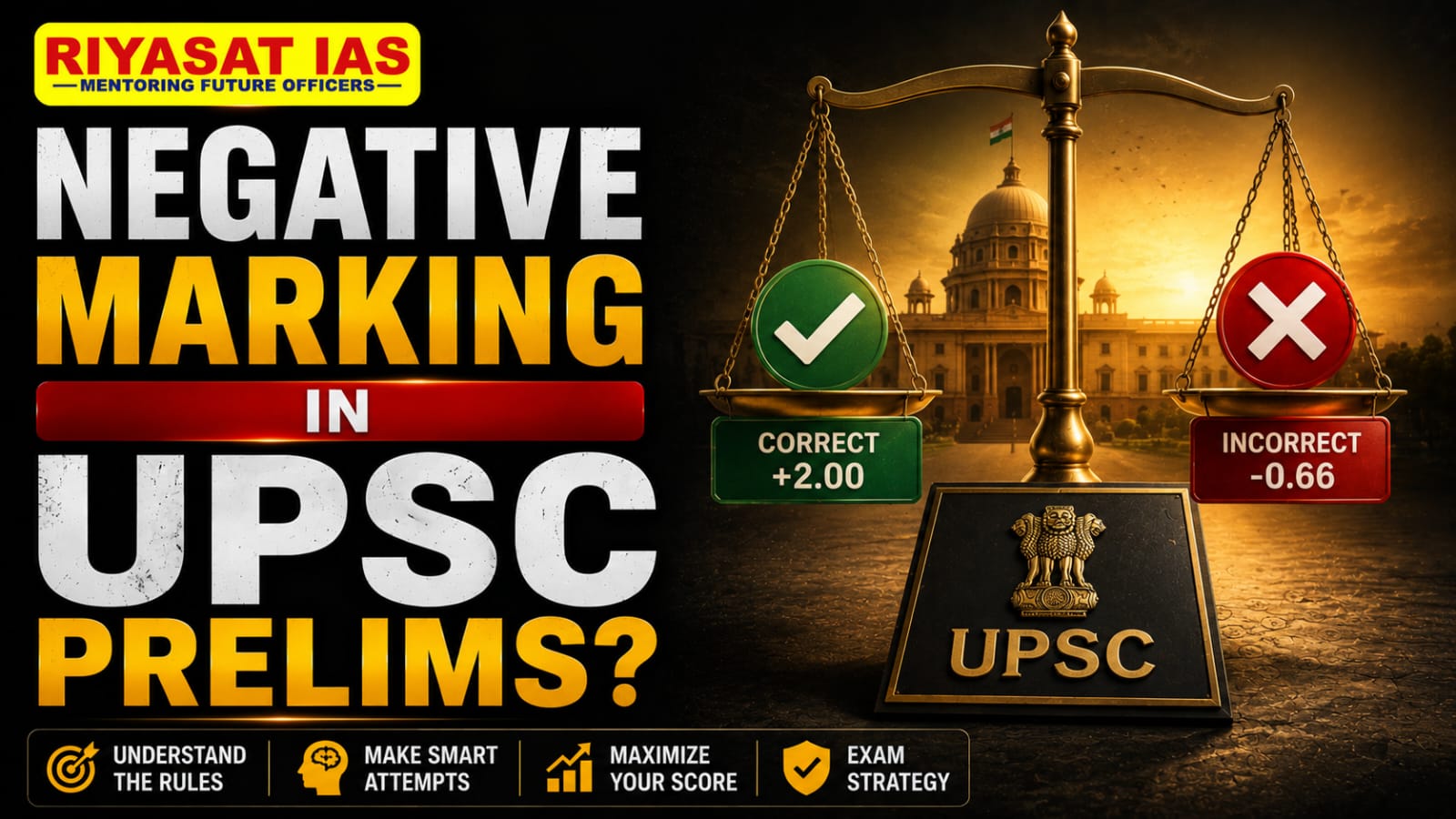
The UPSC Civil Services Examination is one of the exams in India. Every year many people appear for the UPSC Prelims Exam. Only a few qualify for the Mains stage. The reason for this competition is the negative marking system in UPSC Prelims. Understanding marking in UPSC Prelims is very important. A few wrong answers can reduce your final score significantly.
Many aspirants lose marks not because they do not know. Because of poor attempt strategy and too much guessing. This article by Riyasat IAS Mentorship explains UPSC marking, GS Paper 1 marks calculation and CSAT negative marking.
It also gives strategies to avoid losing marks Students looking for information, on UPSC prelims marking UPSC prelims marks calculation and CSAT negative marking can check the detailed explanation below. They can also learn how to avoid marking in UPSC.
What is Negative Marking in UPSC Prelims?
The UPSC Civil Services Examination has three stages:
- Preliminary Examination
- Main Examination
- Personality Test (Interview)
Negative marking applies only in the Preliminary Examination.
In UPSC Prelims, one-third (1/3rd) of the marks assigned to a question are deducted for every wrong answer.
This system is designed to discourage random guessing and test the accuracy and analytical ability of candidates.
There are two papers in UPSC Prelims:
GS Paper 1
- 100 Questions
- 200 Marks
- Merit deciding paper
CSAT Paper (GS Paper 2)
- 80 Questions
- 200 Marks
- Qualifying paper
Both papers have negative marking.
Negative Marking in UPSC Prelims GS Paper 1
General Studies Paper 1 is the most important paper in UPSC Prelims because its marks decide whether a candidate qualifies for UPSC Mains.
GS Paper 1 Marking Scheme
- Total Questions: 100
- Total Marks: 200
- Marks per Question: 2 Marks
- Negative Marking: 0.667 Marks per wrong answer
Since the negative marking is one-third of the marks allotted to each question:
13×2=0.667\frac{1}{3}\times 2 = 0.66731×2=0.667
Therefore, every incorrect answer leads to a deduction of 0.667 marks.
Check this also-UPSC Prelims Exam Analysis 2026
Example of GS Paper 1 Marks Calculation
Suppose a candidate attempted:
- Correct Answers = 70
- Wrong Answers = 30
Step 1 – Calculate Correct Answer Marks
70×2=14070\times2 = 14070×2=140
Step 2 – Calculate Negative Marks
30×0.667=20.0130\times0.667 = 20.0130×0.667=20.01
Step 3 – Final Score
140−20.01=119.99140 – 20.01 = 119.99140−20.01=119.99
Final GS Paper 1 Score = 119.99 Marks
This example clearly shows how negative marking in UPSC Prelims can affect the final score.
CSAT Negative Marking in UPSC Prelims
CSAT, also known as General Studies Paper 2, is qualifying in nature. Candidates must score at least 33% marks to qualify.
CSAT Marking Scheme
- Total Questions: 80
- Total Marks: 200
- Marks per Question: 2.5 Marks
- Negative Marking: 0.833 Marks per wrong answer
Calculation:
13×2.5=0.833\frac{1}{3}\times2.5 = 0.83331×2.5=0.833
Therefore, every incorrect answer in CSAT deducts 0.833 marks.
Example of CSAT Marks Calculation
Suppose a candidate attempted:
- Correct Answers = 65
- Wrong Answers = 15
Step 1 – Correct Answer Marks
65×2.5=162.565\times2.5 = 162.565×2.5=162.5
Step 2 – Negative Marks
15×0.833=12.49515\times0.833 = 12.49515×0.833=12.495
Step 3 – Final Score
162.5−12.495=150.005162.5 – 12.495 = 150.005162.5−12.495=150.005
Final CSAT Score = 150.005 Marks
Although CSAT is qualifying, aspirants should never ignore it because many candidates fail to clear the qualifying cutoff every year.
How to Calculate UPSC Prelims Marks?
Candidates can calculate their UPSC Prelims score using a simple formula.
UPSC Prelims Marks Formula
Final Score=(Correct Answers×Marks per Question)−(Wrong Answers×Negative Marks)\text{Final Score} = (\text{Correct Answers}\times\text{Marks per Question}) – (\text{Wrong Answers}\times\text{Negative Marks})Final Score=(Correct Answers×Marks per Question)−(Wrong Answers×Negative Marks)
Example of UPSC GS Paper 1 Marks Calculation
Suppose:
- Correct Answers = 75
- Wrong Answers = 25
Step 1
75×2=15075\times2 = 15075×2=150
Step 2
25×0.667=16.67525\times0.667 = 16.67525×0.667=16.675
Step 3
150−16.675=133.325150 – 16.675 = 133.325150−16.675=133.325
Final GS Paper 1 Score = 133.325 Marks
Is There Negative Marking in UPSC Mains?
No, there is no negative marking in UPSC Mains Examination.
The UPSC Mains Exam is descriptive in nature. Candidates are evaluated based on:
- Analytical ability
- Presentation skills
- Conceptual clarity
- Answer structure
- Critical thinking
Since there is no penalty for wrong answers, candidates should attempt maximum questions in UPSC Mains.
Is There Negative Marking in UPSC Interview?
No, there is no negative marking in UPSC Personality Test or Interview.
The UPSC Interview Board evaluates candidates on:
- Communication skills
- Leadership qualities
- Decision making ability
- Awareness of current affairs
- Personality traits
- Administrative aptitude
Candidates are not penalised for incorrect answers in the interview stage.
How to Avoid Negative Marking in UPSC Prelims?
Avoiding unnecessary negative marking is one of the most important UPSC preparation strategies.
1. Avoid Blind Guessing
Do not mark answers randomly without eliminating options.
2. Master Elimination Technique
Try eliminating at least two options before attempting uncertain questions.
3. Focus on Accuracy
Attempt fewer questions with better accuracy rather than attempting all questions blindly.
4. Solve PYQs Regularly
Previous year questions help aspirants understand UPSC’s mindset and question framing style.
5. Give Mock Tests
Regular mock tests improve decision making under pressure.
6. Manage Time Properly
Do not spend excessive time on difficult questions.
7. Read Questions Carefully
Many mistakes happen because candidates misread statements or keywords.
8. Leave Completely Unknown Questions
There is no penalty for leaving a question blank.
Smart Attempt Strategy for UPSC Prelims
According to Riyasat IAS Mentorship experts, a balanced attempt strategy is crucial.
Aspirants should focus on:
- High accuracy rate
- Intelligent guessing
- Risk management
- Calm decision making
UPSC Prelims is not only a knowledge test but also a strategy-based examination.
Final Tips by Riyasat IAS Mentorship
Negative marking in UPSC Prelims can significantly impact your final score. Therefore, aspirants must prepare with a smart and disciplined strategy.
The key to success in UPSC Prelims 2026 is:
- Conceptual clarity
- Revision
- PYQ analysis
- Mock test practice
- Intelligent attempt strategy
- Strong CSAT preparation
At Riyasat IAS Mentorship, we guide aspirants with personalised preparation strategy, answer discussion sessions, mock test analysis and smart prelims attempt techniques.
Students preparing for UPSC 2027 should start focusing on accuracy, elimination methods and disciplined revision to avoid unnecessary negative marking and improve their overall score.