
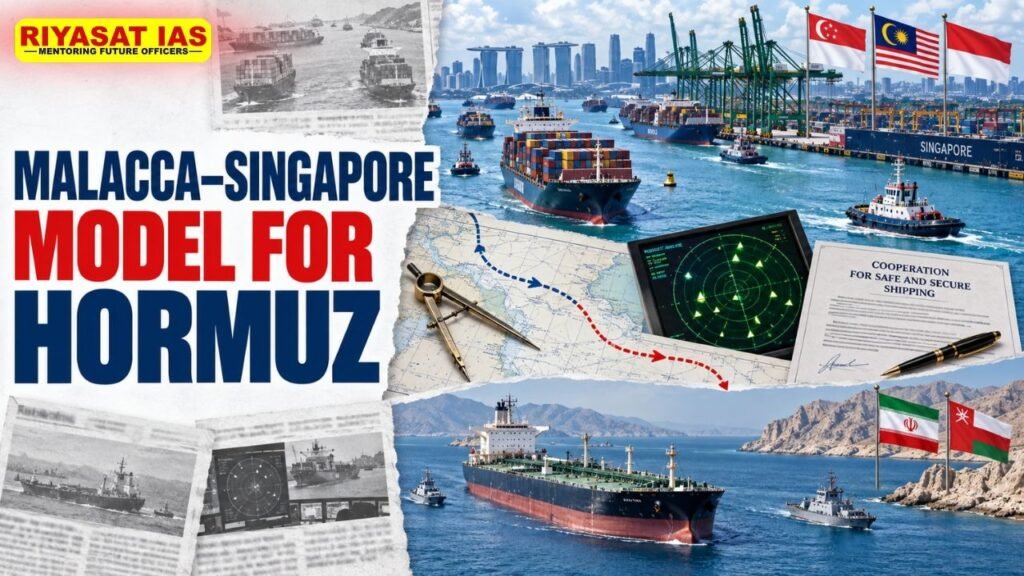
GS-II – International Relations | GS-III – Security | International Maritime Trade
- Strait of Hormuz: The siege warfare in the Strait of Hormuz and around the world continues to suffer, but we may think back on how maybe looking back at the Straits of Malacca or even Singapore.
- Strait of Malacca: With a length of almost 800 kilometres, it is located between the Malay Peninsula and the Indonesian island of Sumatra, linking the Andaman Sea in the northeast to the Strait of Singapore.
- Singapore Strait: About 105 km long, it is the eastern extension of the Malacca Strait and connects the former to the South China Sea.
A Territorial Turning Point
- Earlier Condition: The Straits were considered to be “international” like the high seas, i.e., no country is entitled to any rights over them.
- 1971 Joint Challenge: These two core principles were collectively challenged by the three countries of Malaysia, Indonesia and Singapore in 1971.
- Indonesia: One synoptic map represents Indonesia’s fear as a newly decolonised state about the security of each individual island becoming isolated if refusal to treat the waters within Indonesian waters due to addressing issues of territoriality none-the-less become separations visible on a private map.
- 1957 Declaration: Indonesia declared that all waters “surrounding, between and connecting the islands” were Indonesian waters.
- Sukarno’s line: Taking a firm line with colonial powers as then-Indonesian president Sukarno did (but made wary of great power meddling).
- UNCLOS Negotiations: During the negotiations on the United Nations Convention on the Law of the Sea (UNCLOS), Indonesia argued that its territorial waters were twelve nautical miles from outermost islands.
- Malaysia:
- Revised the position taken at the 1958 UNCLOS conference, and declared a 12-nautical mile territorial sea despite an armed conflict with Indonesia over Borneo in 1963.
- Then date your cooperation bilateral: Malaysia decided to cooperate with Jakarta to the Straits through bilateral contracts and joint naval patrols. Those two nations continue to cooperate very closely to this day.
- Territorial Waters: The Straits are far less than 24 nautical miles wide at their narrowest points. Following this configuration, once the two states asserted 12-nautical-mile territorial seas, they met in the middle, leaving no band of high seas or exclusive economic zone (EEZ) between them.
- Innocent Passage: It meant that under the contemporary customary law of the time, the Straits were merely territorial seas where foreign vessels had only a right of “innocent passage” into and out of international waters.
- Limits: Indonesia or Malaysia could revoke this right on security grounds, and it did not cover underwater submarines.
- Joint Statement: In 1971, the states made a statement together proposing an organisation consisting of government representatives from each of the three states as well as autonomous rules for administration of the Straits.
- Transport Type: Singapore, the island nation reliant on trade and shipping, did not exactly agree to declaring the Straits “not international” but he did strike a common line with Malaysia over safe navigation.



The Straits and the Great Powers
- Japan’s Engagement: Japan was an important player, through the Malacca Strait Council funded by Japan, in seeking cooperation with the three states as opposed to a regime internationalised.
- U.S. and Soviet Union: The United States and the Soviet Union , otherwise rival nations. With respect to this single issue they were allies — keeping the Straits “international” by continuing in international waters with ships as having been granted through that status continuing-retained “right” — continued , politically uncluttered transit.
- Transit Passage: At the earliest stages of articling UNCLOS in the 1970s, the United Kingdom, proposed the idea of “transit passage,” for straits that connect one area of high seas and associated EEZ with another.
- Nature of Transit Passage: A right to only transit in a “continuous and expeditious” manner, without stop or loiter, but one that also applied to warships meaning it went beyond just innocent passage.
- Indonesian Compromise: Indonesia conditionally accepted this formulation in exchange for more security for its archipelago that was ultimately addressed separately through UNCLOS.
- Among Malaysia’s concerns were the safety of the surrounding environment; insurance requirements; and acceptable vessel draught.
Cooperative Mechanism of 2007
- Cooperative Mechanism: In 2007, the three nations established a Cooperative Mechanism with the international community that reflects Traffic Separation Scheme such as what Iran and Oman had agreed for Strait of Hormuz since the 1960s.
- Funding mechanism: The 2007 mechanism core elements included, contributions from user states and industry to a fund for aids to navigation, hydrographic surveys and safety projects jointly managed with the littoral states.
- Aids to Navigation Fund: Provided on a voluntary basis by grants from philanthropic non profit making foundations like the Nippon Foundation and the International Foundation for Aids to Navigation, and other industry stakeholders and states interested in successful safety management of transport through the Straits.
- No tolls: These contributions are not considered to be tolls.
- Administration: The administration of the fund is performed in a rotating manner by a committee composed of representatives from the three littoral States as well as from the donors.
- Free passage: The three littoral States — Indonesia, Malaysia and Singapore — charge no fees, tolls or any other kind of payment for access to ships exercising their right of transit passage.
Geographic Parallels: The Strait of Hormuz
- Geographical Proximity: Spatially there are parallels between the Strait of Hormuz and Malacca-Singapore Straits as the territorial waters of Iran and Oman overlap, thereby rendering certain segments of the Strait part of their respective EEZs.
- The 1993 Law of Iran: In 1993, the Islamic Republic of Iran, which has not accepted UNCLOS ratified a law stipulating that foreign warships must obtain its permission to pass through the Strait.
- Ongoing Contention: That still proves a controversial point today.
- Regional relations: Persian Gulf nations have gone both ways with each other.
- UAE–Iran Relations: One example was the United Arab Emirates was a top trading partner of Iran.
- Qatar: Qatar is a Persian Gulf country whose support of Iraq’s talks with Iran and Oman being noticed. It had also mooted the Malacca-Singapore Straits as a case in point.
- U.S. Position: But, even if the Gulf countries reach consensus on a framework to which they all could agree upon, the U.S. has indicated that it might not accept that content or shape of agreement.
Differences Between the Two Straits
- UNCLOS context: The Malacca-Singapore dispute was resolved in the process of implementing UNCLOS itself, when trade-offs were baked into negotiations on an instrument meant to govern all the worlds oceans.
- Core Issue in the Strait of Hormuz: Defending security from Iran.
- Iran’s Demand: Iran is asking are calling for every nations return to the strait of Hormuz, and those who wish to do so.
- UPDATE: Iran-Oman reached an initial understanding to reopen the Strait of Hormuz; that has not happened and the U.S. will not accept it for now.
- Context Shift: While the technical details share direct parallels, the context is changed.
Way Forward
- Littoral States: Enhance cooperation among the actors in the Strait of Hormuz.
- Regional: Establish a framework for the Strait of Hormuz that is acceptable to littoral states and user states.
- Safety of Navigation: Safeguarding maritime safety, protection of the environment and unimpeded commercial shipping.
- Talk and Bargain: Use diplomacy negotiations to resolve differences and deal with Iran’s security concerns.
- International Cooperation: Promote cooperation between littoral states, user states and the international community with due respect for the relevant body of international law.
Conclusion
- Balancing Interests: The experience of the Malacca-Singapore example illustrates efforts to accommodate coastal states in addressing serious security issues like piracy29 within the context of sea lanes while keeping open passages for free navigation and commerce.
- Cooperative approach: The challenges of the Strait of Hormuz are conveyable by a framework which is cooperative and reflects mutual interests with dialogue and international cooperation.
UPSC Mains Practice Question
Q. “The Malacca-Singapore Straits provide important lessons for resolving the challenges surrounding the Strait of Hormuz.” Discuss the territorial, legal and geopolitical dimensions of the two straits.





 Ravi Raaz
 Hassan Khan
 Shadab Ali